Heads up! Just posted a review of the Hobbit trailer. Head on over to In a Hole in the Ground to take a look!
Showing posts with label Landon. Show all posts
Showing posts with label Landon. Show all posts
Sunday, December 18, 2011
In a Hole in the Ground
Hey gang,
I have a confession to make: my excitement over the Hobbit movies has reached an embarrassing level. And, in honor of that, I've started a new project on a little blog of my own. I'll be posting over there from time to time. Feel free to check it out:
In a Hole in the Ground
Later . . .
I have a confession to make: my excitement over the Hobbit movies has reached an embarrassing level. And, in honor of that, I've started a new project on a little blog of my own. I'll be posting over there from time to time. Feel free to check it out:
In a Hole in the Ground
Later . . .

Sunday, November 6, 2011
Dark Empires: Prologue
Sorry for posting twice-in-a-day. Just wanted to let you know a prologue is now up on my Dark Empires document over on GoogleDocs. Take a look when you get a chance. Specifically, I'm wondering if it makes any sense at all. Its meant to be a little mysterious and disorienting . . . but I'm worried it goes a bit too far.
How are you guys liking making the comments over on GoogleDocs? It seems to work rather well, IMO, but what's your opinions?
Heres the link again, in case you need it:
Dark Empires: Prologue
How are you guys liking making the comments over on GoogleDocs? It seems to work rather well, IMO, but what's your opinions?
Heres the link again, in case you need it:
Dark Empires: Prologue
Epic 1
Ok, its taken forever . . . but here's the first EPIC cartoon strip. Now, I'm dissatisfied with a number of things with this first strip, but I wanted to get your general reactions to it. I need to work out a way to digitize the line drawing better, cause the way I did it looses too much detail on the panes that are more "zoomed out". And I think I'm gonna try coloring the next one in Photoshop instead of Illustrator. I also want to go for a bit more detail than I did in this one, both in drawing and coloring. But my biggest question is this: is this thing even remotely funny? Let me know!
If you click on this image it should take you to a larger version of the comic.

Later . . .
P.S. Anybody going to the release of Alloy of Law tomorrow?
If you click on this image it should take you to a larger version of the comic.
Later . . .
P.S. Anybody going to the release of Alloy of Law tomorrow?
Wednesday, November 2, 2011
Dark Empires: An Outline in Progress
So, Travis inspired (and Jesse prodded me) into trying this NaNoWriMo thing . . . I can't promise I'll be 100% more productive than I have been the past few months, but I'm gonna give it a shot. Also, while I'm at it, I'd like to try something new: instead of posting my stuff right here in the post, I'm gonna give you guys a link to a google doc that has my new stuff. I've added all of you to the document so you should be able to post comments to it. I think this'll be a better system cause you'll be able to select particular sentences/paragraphs/lines that you want to comment on, and then by adding a comment it'll highlight that specific line and point to the comment. That way when you do comment on somebody's work, they'll be able to see right where you're commenting.
For those of you who haven't used googledocs, to make a comment you simply highlight the piece of text you want to comment on, then go to the Insert menu and select Comment. A comment box will pop up and you'll be able to write your thoughts up. I'll provide an example on the googedoc.
So, here's the link to my outline for the scifi novel I'll be writing:
Dark Empires
For those of you who haven't used googledocs, to make a comment you simply highlight the piece of text you want to comment on, then go to the Insert menu and select Comment. A comment box will pop up and you'll be able to write your thoughts up. I'll provide an example on the googedoc.
So, here's the link to my outline for the scifi novel I'll be writing:
Dark Empires
Friday, August 26, 2011
Halfling Concept
Here's another one, not sure I'm as satisfied with this one:

What do you guys think?
Name ideas? Kylie says Fen or Toli (pronounced Tall-ee) or Steve.

What do you guys think?
Name ideas? Kylie says Fen or Toli (pronounced Tall-ee) or Steve.
Wednesday, August 24, 2011
Another EPIC sneak peak
Ok, still plugging away at this crazy idea. Here's the first of several character mock-ups.
Meet Turq, an exiled dwarf with a speech impediment:

Meet Turq, an exiled dwarf with a speech impediment:

Wednesday, August 17, 2011

Wednesday, July 13, 2011
Sunday, July 10, 2011
Descent of the High Families of Greater Amar
Ok, so this is mostly to prove (to myself?) that, contrary to popular belief, I have been working on stuff. Now, the work I've been doing is all worldbuilding, but thats ok, cause I enjoy it :)
So, this is a (as yet incomplete) genealogy showing how most of the main characters in my fantasy story can ultimately trace their family lines back to a common ancestor.
95% of the nobility in Amar claim descent through some branch of this family tree . . . whether or not the claim is true or not.
More will come during the week.
Later . . .
So, this is a (as yet incomplete) genealogy showing how most of the main characters in my fantasy story can ultimately trace their family lines back to a common ancestor.
95% of the nobility in Amar claim descent through some branch of this family tree . . . whether or not the claim is true or not.
More will come during the week.
Later . . .
Thursday, June 16, 2011
Tuesday, June 14, 2011
Another Sci-Fi Link
Ok, so here's another Hard-SF link. Orion's Arm is a collaborative world-building group that has built a huge universe that tries as hard as possible to be scientifically accurate (as far as we understand the physics and such at the moment).
This link is to their encyclopedia area where you can browse around. I like it, cause if you're ever wondering how an antimatter drive would work, you can look it up here with fairly high confidence that the explanation you'll get is accurate.
Enjoy!
Later . . . .
This link is to their encyclopedia area where you can browse around. I like it, cause if you're ever wondering how an antimatter drive would work, you can look it up here with fairly high confidence that the explanation you'll get is accurate.
Enjoy!
Later . . . .
Sunday, June 12, 2011
Book Review: A Deepness in the Sky
Ok, so I have been more than absent on the blog over the last few months . . . end of school and even more importantly, getting the house ready for our new little baby. Walter Jack Burgener was born on June 1st and has been keeping mom and dad busy ever since. But, over the next few days I'll try and gear up to start writing again. Anyways, to kind of get the writing juices flowing I thought I'd do a quick review of a book I just finished reading (credit to Jesse for getting me hooked on this series in the first place). So, on to the review:
________________________________________________________________________________
 This book is fantastic.
Vernor Vinge is probably most well known for an earlier hard science fiction novel A Fire Upon the Deep, a galaxy-spanning tale of super-bright AI gods who interact with "regular" men and women via mortal avatars. A Deepness in the Sky is a pseudo-prequel that details the earlier adventures of one of these avatars, a man named Pham Nuwen, who in AFUD (hehe, great acronym) was used almost like a puppet by a super-bright AI. A Deepness in the Sky takes place thousands of years earlier on the other side of the galaxy and deep within the "Slow Zone" where futuristic technologies like faster-than-light travel and nanomachines are an impossibility.
At the start of the story, Pham Nuwen is an old man who has been trying--across dozens of start systems and several relative millenia--to create an enduring human empire out of the Queng Ho, space-faring traders who visit nearly every corner of human space.
A Queng Ho fleet picks Pham up from an out-of-the-way star system where he'd been marooned and heads for one of the last great mysteries in human space--the On-Off star, a variable sun with a single orbiting planet. For centuries humanity has monitored this enigmatic system and the radio signals that stream from the planet. It is the first evidence of a technologically advanced alien species ever found, and the Queng Ho race towards the distant world with dreams of unimaginable discoveries . . . and equally unimaginable profits stemming from those discoveries.
Too bad they're not the only kids on the block. They arrive at the On-Off system at nearly the same time as a second human fleet shows up--the militaristic Emergents are a relatively new civilization, and at first the two fleets feign friendship and attempt to work together; however, a sneak attack by the Emergents leaves both fleets crippled and only a handful of both communities alive. Their only hope of survival is to wait year after year in the coldness of space while the aliens on the planet below develop an industrial civilization capable of rebuilding the human ships.
Ok, thats enough of spoilers . . . the rest of the book takes off from that point and doesn't let up until the final page.
True to Vinge's style, the aliens, or "Spiders" as the humans call them, are amazingly rendered. We see the Spiders both from their own point of view, and from the human's point of view, which allows the reader to experience the aliens as true extraterrestrials, and as normal beings living normal lives on their normal planet. This juxtaposition is only heightened towards then end of the book when the two species finally make contact.
Like AFUD, A Deepness in the Sky is short on true military action, but nevertheless includes a lot of action sequences that leave you breathless, especially towards the end. In fact, this story probably has more action than AFUD, though a lot of it is the type of fighting that we'd be more familiar with--the Spider nations go through several warring periods, beginning with a global war reminiscent of both WWI and WWII, a decidedly Cold War and then a final war that could have come straight from a Tom Clancy novel . . . something that our world, thankfully, has managed to avoid so far.
There are dozens of characters with their own story arcs--both human and Spider, but Pham Nuwen was definitely my favorite. I don't think I've ever met a character who was so good and yet had such terrible plans for humanity. His actions and machinations really drive the whole story.
Now, I don't wanna give the whole story away, but there are a few things that Vinge nailed that I gotta mention:
________________________________________________________________________________
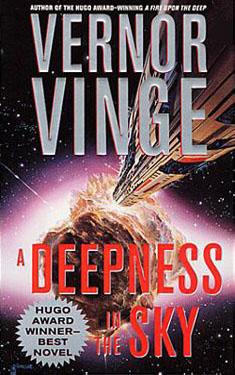
Vernor Vinge is probably most well known for an earlier hard science fiction novel A Fire Upon the Deep, a galaxy-spanning tale of super-bright AI gods who interact with "regular" men and women via mortal avatars. A Deepness in the Sky is a pseudo-prequel that details the earlier adventures of one of these avatars, a man named Pham Nuwen, who in AFUD (hehe, great acronym) was used almost like a puppet by a super-bright AI. A Deepness in the Sky takes place thousands of years earlier on the other side of the galaxy and deep within the "Slow Zone" where futuristic technologies like faster-than-light travel and nanomachines are an impossibility.
At the start of the story, Pham Nuwen is an old man who has been trying--across dozens of start systems and several relative millenia--to create an enduring human empire out of the Queng Ho, space-faring traders who visit nearly every corner of human space.
A Queng Ho fleet picks Pham up from an out-of-the-way star system where he'd been marooned and heads for one of the last great mysteries in human space--the On-Off star, a variable sun with a single orbiting planet. For centuries humanity has monitored this enigmatic system and the radio signals that stream from the planet. It is the first evidence of a technologically advanced alien species ever found, and the Queng Ho race towards the distant world with dreams of unimaginable discoveries . . . and equally unimaginable profits stemming from those discoveries.
Too bad they're not the only kids on the block. They arrive at the On-Off system at nearly the same time as a second human fleet shows up--the militaristic Emergents are a relatively new civilization, and at first the two fleets feign friendship and attempt to work together; however, a sneak attack by the Emergents leaves both fleets crippled and only a handful of both communities alive. Their only hope of survival is to wait year after year in the coldness of space while the aliens on the planet below develop an industrial civilization capable of rebuilding the human ships.
Ok, thats enough of spoilers . . . the rest of the book takes off from that point and doesn't let up until the final page.
True to Vinge's style, the aliens, or "Spiders" as the humans call them, are amazingly rendered. We see the Spiders both from their own point of view, and from the human's point of view, which allows the reader to experience the aliens as true extraterrestrials, and as normal beings living normal lives on their normal planet. This juxtaposition is only heightened towards then end of the book when the two species finally make contact.
Like AFUD, A Deepness in the Sky is short on true military action, but nevertheless includes a lot of action sequences that leave you breathless, especially towards the end. In fact, this story probably has more action than AFUD, though a lot of it is the type of fighting that we'd be more familiar with--the Spider nations go through several warring periods, beginning with a global war reminiscent of both WWI and WWII, a decidedly Cold War and then a final war that could have come straight from a Tom Clancy novel . . . something that our world, thankfully, has managed to avoid so far.
There are dozens of characters with their own story arcs--both human and Spider, but Pham Nuwen was definitely my favorite. I don't think I've ever met a character who was so good and yet had such terrible plans for humanity. His actions and machinations really drive the whole story.
Now, I don't wanna give the whole story away, but there are a few things that Vinge nailed that I gotta mention:
- Keeping the science real . . . Vinge has created a compelling story with lots of action and excitement without breaking any of the rules of physics (as we know them, of course)
- Alien aliens . . . the Spiders are weird, and perhaps weirder by the end of the book because at first they don't seem all that weird. Heh, how many times can I use the word weird?
- Timelessness . . . . Vinge creates a world full of amazing technology, but manages to be just vague enough about specific machines and functions that the story isn't dated like so many old classic sci-fi stories.
Anyways, I'll end this little post by giving A Deepness in the Sky ten thumbs way way up (yeah, thats how many thumbs your average Spider would have). In fact, this story is so good I would actually recommend reading it before A Fire Upon the Deep. In my opinion that'd make both stories more enjoyable.
Later . . .
Tuesday, March 29, 2011
Writing Helps: World-building checklist
A nice list of world-building necessities that I ran across here on the SFWA website.
Sunday, March 27, 2011
I Am Not A Soldier 3
To my right, about two klicks from where I was crouched in the ash and hidden from view by a low, blackened ridge, a projectile battery of some kind was pounding away, firing in our general direction, but the shots were all passing high over my head with furious buzzing whines and I figured the aliens had panicked and started firing at the column of smoke ascending lazily from our pod.
Raising my right arm, I launched a micro-probe from one of the magazines concealed in my forearm plate. The tiny ‘bot drifted up into the trembling air on a mini a-grav floater, twitching as it activated it’s guidance fans and I switched my main viewscreen over to its tiny cameras. For a half second my head spun as I tried to orient myself to the new vantage point—my body felt like I was suddenly ten meters in the air and rising. The ‘bots cameras gave me a sweeping view of the battlefield: a tumbled land of black, symmetrical ridges and tall needle-thin towers that looked like something you’d find in an oil refinery. A thin sheet of ice and snow dusted everything and stirred fitfully in the stiff breeze, obscuring the ground surface.
To the west another volley of missiles were rising from some sort of industrial complex—the arching vapor trails were graceful enough, but the launch site looked like it had been abandoned fifty years back. Maybe twenty klicks away on the northern horizon—the planet was a small one, much smaller than its gravity suggested, and from the ‘bots vantage point the horizon looked unnaturally close—crouched a higher mass of oddly angular hills. Those hills were our target.
The area between our position and the hills was lousy with fighting and half-obscured by rapidly spreading banks and columns of smoke and flame. From fifty meters up I counted another twenty battery positions like the one I’d just spotted and a few scattered sniper nests—well hidden, but the ‘bots infrared cam picked their locations out as nicely as coal on fresh snow. A dozen primitive flyers were rushing in from the launch area, helicopters of some sort that were hugging close to the ground. But not close enough. Some of our gang who’d landed closer to the launching zone opened up as the choppers passed overhead. Two of the birds just shattered in midair, spitting flame and metal in all directions and their comrades scattered in all directions like a flock of pigeons—but not fast enough. Three more blew apart before they’d slipped out of range.
This was barely gonna merit the term “battle”.
Switching the ‘bot to autonomous mode, I ducked low and cupped a hand over my ear—a useless gesture, encased as I was in armor, but old habits are hard to break. “Boots, do you copy?”
“What’s the sitch, DA? Rogers is already moving.”
I relayed what I’d seen, all the while scanning the flashing air above my head and trying to ignore the rapid chatter of the nearby emplacement and the whine of the bullets. That damn battery would not shut up!
When I was finished, Boots began rattling off orders. “I’m joining Rogers and we’ll pave the way north clean so Westover and Tiang can follow us in with the zero-two-zero for support-and-cover—though why the hell Cent-Ops sent us down with the ‘Peater I’ll never know. Vlad will follow us in about two klicks behind—he’s got the Sabers and Apaches on the phone, but the other squads and the Gambler are giving him fits. Some type of cachanga jamming. You’ll cover our back sides, following behind Vlad; but first I want you to go serve that battery crew their huevos for lunch. Read me?”
“Loud and clear, sir.”
“That’s Boots to you, mierda, and don’t forget it. And remember DA, minimal casualties. We’re here to win hearts, minds and information, not lay this alien crap-shooters out in body bags.”
“Copy that, Boots.”
“Good hunting then. Chime in when you’re finished.”
The line went dead and I sank lower, hunkering down in my suit. This was it then. A thousand lightyears of travel and five months of training and it all came down to this one moment. I wasn’t ready. I still wasn’t ready, even after all the drills and practice and endless hours of work. Somehow, deep down in the center of my gut, I knew that I would never be ready. Oh hell. I am not a soldier.
It wasn’t that I was afraid to die. Not right then. My armor was too good, my weapons too powerful, and all this freaks could throw at us were metal bullets and a few nukes. It’d be a cake-walk. No, what I was afraid of was what I could do to them. I’d seen a lot of accidents during the first few weeks of training, bones broken, limbs torn off, heads stoved in—all because we hadn’t learned yet how to control the armor. I still had nightmares about those first hundred hours, when not a day passed without someone I knew dying.
I didn’t want to do that to anyone, alien or human. What’s worse, I wasn’t sure if I could do anything like that. I’d never been a violent person, even back on Earth. What if, when it all came down to it and one of my mates’ lives was on the line, I didn’t—couldn’t—do what needed doing? How could I live with that?
Thankfully, my orders right then and there were crystal clear—put the battery out of commission fast, and do it without killing. That much, I could do. Taking three slow breaths, I switched the VMR over to non-lethal rounds and breathed one last prayer before vaulting straight up into the pale sky.
My armor-enhanced jump rocketed me up and past the steady stream of projectile fire—despite my suit’s constantly adjusting chameleon skin, whatever was manning the gun battery must have spotted something as I raced skyward, because the tracer-illuminated firing line spasmed unsteadily towards me for a half-second before settling back to continue shooting uselessly over the smoking ‘pod.
Fifty meters above the ground the suit’s thrusters kicked in, kicking me higher still. Despite the shifting veil of snow obscuring the ground below, the air around me was perfectly calm, a frostbiting -40° C according to my suit’s thermometer. Higher still, the sky above me was a roiling mass of flaming clouds and expanding explosions—all that the Gambler had left of the second volley of enemy rockets.
Scanning the ground between my dangling feet, I quickly spotted the gunnery nest. Wedged tightly into a crater that had blown a hole into the crest of one of the strange, symmetrical ridges that all seemed to radiate out from the compound Boot’s and the others were heading towards. My HUD highlighted the squad—little more than red-shaded dots at this altitude—leapfrogging down a deep defile between two of the ridges.
The gun-battery was a joke. From where I was—still rising higher—it looked like we’d definitely managed to catch the aliens with their pants down. Besides the crater itself, a thin wall of rubble piled around the crater rim was the only visible concession to defense. Focusing on the crater I mentally locked the suit onto the nest and then let the nav-computer take over. The armor’s internal gyros spun me over so I was suddenly falling face-first towards the ground. For a moment everything was silent, except for the soft sound of the thin air whistling past my external microphones. Then my thrusters roared back to life and I was suddenly a one-man meteor shower streaking towards a cruise-controlled collision with the gun-battery.
Two hundred meters above the gun nest my HUD started identifying targets—four smaller blips clambering over the gun emplacement and a fifth hostile that seemed to be directing the operation from the opposite wall of the crater. A smaller side-screen was projecting the course of my flightpath, and if things held steady for 0.2 seconds longer I’d bull’s-eye the crater dead center, landing right in the middle of the targets.
One tenth of a second later the internal gyros kicked in again, flipping me right-side-up just as the thrusters gave a final blast, slowing my spine-shattering descent to a merely led-breaking fall—nothing the armor couldn’t handle.
I landed in a crouch, legs splayed wide and balanced on one palm, VMR held high, dust and grit and snow kicked up from the thruster-fire swirling around me in a raging maelstrom so thick I should have been blind. Should being the operative word here.
Snapping the VMR down into an active firing stance I whirled around towards the larger, final target my HUD had identified. The crater was still too choked with flying sand and snow to see anything on my own, but my suit’s infrared viewers painted the chaos with more than enough detail. My target was a weird gecko-like creature, glowing orange and yellow in the infrared and frantically trying to claw its way up the rubble embankment of the crater rim with at least eight pairs of limbs, shrieking in a piercing wail almost too high to hear. I snapped off a single round—a varient of rubber bullet designed for maximum non-lethal stopping power—and nailed the lizard what I guessed was it’s torso. The thing dropped immediately and rolled back down the slope towards me.
Something slammed into me from behind, pitching me forward. My legs tangled in the lizard-thing’s mess of arms and legs and I went down hard. Something beneath me gave way with an audible SNAP and I bit off a hoarse curse. The last thing I wanted was to crush the lizard I’d already managed to drop.
Using my own momentum, I turned my fall into a roll, the suit’s powerful steel muscles actually pushing me up the hill. The weight on my head and shoulders suddenly released and something—whatever had slammed into me—gave a strangled scream. I whipped my head around just in time to see my attacker slam spread-eagle into the crater wall and stay there, unconscious or dead. At the moment, I couldn’t find the energy to even care which it was.
Lurching upright I jerked back around towards the gun, bringing my VMR up just in time. The final three targets were charging directly towards my, screeching with weirdly child-like voices. They were identical to the alien that had jumped me—some kind of weird bugs that looked something like what you’d get if you threw a shrimp, a praying mantis and a centipede into a blender. The smoke and dust had cleared enough for me to see them in the visible light—slug white bugs with translucent carapaces wearing some kind of primitive armor, almost like the Kevlar stuff old Earth SWAT teams used to wear. They were short, none of them standing any more than a meter tall, and I would have laughed at their attack if they hadn’t all been so obviously bent on killing me.
I managed to pull off two quick shots before the bugs were on top of me. The first slug took the nearest alien clean in the chest from only two meters away, blowing it back against the gun battery with a sickening crunch. The second shot actually blew one of the second bug’s arms right off, but the thing just kept coming, barreling into me like a hammer; but this time, I was ready.
By the time the third and final bug had slammed into my chest, I’d activated my suit’s electrostatic defense skin. A thousand volts arced across the surface of the armor, and neon-blue bolts of electricity curled around the two bugs, both of which went stiff as boards, jerking and twitching like puppets on a string until I finally powered the defense field down. Groaning and still twitching, but thankfully very much alive, the two aliens went limp and fell to the ground.
My lungs burned like I’d just ran a marathon and my pulse was a thunderstorm in my ears. Sweat stung my eyes and more than anything I just wanted to lay down and sleep the next couple hours away.
Instead I called in.
“Boots, this is DA calling in.”
A few seconds later the sergeant responded, voice crackling and skipping with static. “Copy that DA. What’s the word?” Questions:
- How was the action in this scene?
- Any problems with blocking, or was the environment pretty clear?
- I'm trying to reveal the nature of the planet slowly. Is it working, or do you feel like you still haven't scene enough?
- The dialogue is my lame attempt at sounding 'military-ish'. How is it? Any suggestions?
- Anything else?
Sunday, March 20, 2011
I Am Not A Soldier 2
Ok, here is the second part to my sci-fi short story. It picks up right where the other one left off.
____________________________________________________________________
____________________________________________________________________
The drop-pod itself is like a gigantic onion—as it screams down, successive layers of braking flaps less than ten nanometers thick blossom open like flower petals. The atmospheric drag on the flaps is unbelievable—the things light up like Roman Candles on the Fourth of July and burn completely away in less than a hundredth of a second. Then the next layer of brakes flares open, and then the next. Bam. Bam. Bam. You get the picture. The bottom line is, by the time the drop-pod is five hundred meters above the surface it’s decelerated to about 1000 meters per second—depending on the atmosphere of the planet and some other stuff only engineers really care about.
At that point the ablative shielding on the pod’s nose has boiled away and the retro-rockets kick in, firing a magnetoplasma pulse for 0.01 seconds, slowing the pod down to a survivable speed and—coincidentally—frying anything within 100 meters of the target zone.
Now, nobody could survive any of this—not the gut-wrenching acceleration out of the ship or the spine-shattering deceleration half a second later—if it weren’t for the miracle of artificial gravity. A-grav is another handy bit of tech we inherited from the trash that pasted Earth—not that it makes up for losing our homeworld, but it does make life a little easier. A net of a-grav projectors ring the inner chamber of the pod, working like sixty during the descent phase to cancel out the g-forces rattling through the pod. The only problem is the computers running the projectors can only process so fast, so about one percent of the g-forces still make it through the null-field—and that one percent is enough to rattle your teeth out of their sockets. But at least you make it down the gravity well alive.
Of course, this whole process was theoretical. Nobody—at least, no human—had made a drop before. We, the spaceborne marines of the UFS Ruin’s Gambler were the first.
The whole drop process, from start to finish, flashed through my mind as I settled into my cocoon between Boots and Rogers and snapped my VMR into the forward bulkhead
Rogers was already grumbling about his stomach but I tuned him out and tried to focus on the muted sound of the cocoon latching onto my armor. I hadn’t said a prayer in months—losing everything had kind of tarnished my opinion of the Big Guy upstairs—but I figured now was as good a time as any to pick up the habit again.
Please God, get us out of this alive. And help me not to puke during the drop. Amen.
Behind me, Westover had produced a fist of cigars and was passing them out to Bergstrom and Tiang.
“I saw this on an old movie once.” I could practically hear the nut grinning through the radio as he passed three more cigars forward to us. “Always gotta have a cigar for the victory celebration. Some crap about fat ladies and singers.”
“Bucha!” Boots’ faceplate popped open long enough for him to drag the cigar across his upper lip. Eyes rolling up, he sighed contentedly. “This is a Cubano! How’d you sneak these on board, basura?”
The question elicited a nasty chuckle from Westover. “I put them in a plastic bag and swallowed ‘em before we were herded off Earth. Getting them back, that was the hard part.”
There was a collective groan through the com-frequency and Boots dropped his cigar, face twisting in a horrified grimace as his helmet snapped shut. “Westy,” he choked out over the radio, “if we make it down in one piece, I’m gonna kill you.”
“Ah, common Boots. I was only teasing.”
The crimson prep-light switched on and my timer started pulsing in the corner of my vision. Twenty seconds to drop.
Above my head, a bank of vents slide open and with a hiss a thick gray cloud of nano-bots splashed down over me. Hurriedly stowing my cigar in my utility pack—I didn’t care what Westy had done with the things, I wasn’t going to let a genuine Cuban cigar go to waste—I shut my eyes and tried to regulate my breathing, just like they’d trained me.
The foggy nano swarm quickly filled the cabin, so thick I couldn’t see Boots, Rogers or the bulkhead twenty centimeters in front of me. Then the fog was inside my helmet and I could feel the invisible machines sliding down my throat and filling my nostrils, thick and oily. I closed my eyes and my chest went cold as the swarm filled my lungs and I started to gag—we’d already done this twice in training, but each time was just as bad as the first—but I could still breathe, even if it felt like my lungs had been pumped full of water, so I fought the panic down and tried to settle further into my cocoon.
“This is it, boys.” Boots was all business again, as calm as ever. “Either the shortest trip we’ll ever make, or the longest. Hooah!”
Ten seconds to drop.
Without warning the soft, cloudy nano swarm turned hard as concrete, freezing all of us in place. My brain and body rebelled instantaneously, every muscle and cell screaming with a panic I could barely contain. There was no air! I can’t breathe! The thought screamed furiously between my ears, and I wanted to scream with it, only I couldn’t. My jaw was locked in place too.
Only I could. The nano swarm kept a constant, even flow of oxygen passing through my lungs, and even worked to keep my blood circulating through my immobilized heart. Gradually, as my trembling body realized it was not asphyxiating, I regained control.
Now for the hard part.
Five second to drop.
The ship-wide frequencies were alive with chatter, scan-techs keeping up a constant flood of information about conditions dirt-side, officers calmly passing orders to all parts of the ship, defense crew chiefs cutting in every now and again to report on closing missiles or other threats.
“Surface winds decreasing to twenty meters per second.”
“Prepare for a front portside burn, ten seconds.”
“Ready for burn, sir.”
“Two bogeys at three hundred kilometers!”
“Target acquired—neutralized.”
I was so caught up in the action that I almost forgot about the drop. My timer finally reached 00:00:00 and a warning siren began wailing. I had a half second to wonder if I’d feel anything when we launched—and then a force like a million tons of lead slammed into my chest, knocking the nano-propelled wind right out of me. My cocoon groaned around me, the webbing and padding creaking in protest. The pod began to bounce and rattle, vibrating hard enough to make me wonder if the ship was falling apart around me. A sound like a train whistle—only a thousand time louder—filled the cabin, and then another force every bit as strong as the first slammed into my back, throwing me against my shoulder restraints. Something exploded just beyond the forward bulkhead—the retro-rocket, I realized dimly—and I pressed further into my restraints until we finally came to a sudden, screeching halt.
I wanted to die. Every part of my body was burning in agony, and I just wanted to lay back and die, but the pod was already unfolding, the nano swarm evaporating in a gray-black haze, and the harsh light of this new, alien world burning through my helmet’s cameras.
Boots was already up on the edge of pod, framed by columns of roiling smoke and bright shafts of cold, blue-tinged light, the skin of his suit already shifting to blend in with his surroundings.
“Let’s move boys!” he shouted, twirling his free hand above his head. “Go! Go! Go!”
My cocoon popped open and I lurched forward, jerking my VMR free and cursing as I clambered past Boots to begin securing the area—that’s my job, along with Rogers, who was already ducking over the opposite end of the pod. Behind me, Westover was helping Tiang assemble the heavy weaponry, and Bergstrom was crouched beneath Boots, shouting across half a dozen frequencies as he frantically tried to establish communication with the Gambler and the other squads.
The retro-rocket had burned clear an area the size of a football field, leaving on strange charred shaped I didn’t recognize and ankle-deep ash that puffed up in fine clouds as I tried to wade through it. Tried, because gravity on this rock was about 70% what I was used to, and despite hours of training during the past weeks, I was nearly falling with every step. Finally, after what seemed like hours, I forced my body into the weird half-jog half-jump that we’d been taught, and made for the edge of the blast zone.
Explosions were rocking the ground on all sides, making keeping my feet extra-difficult. The alien suckers on this rock were a primitive lot—all they had to throw at the Gambler were chemical missiles with fissionable warheads. But they had a lot of these missiles, and it looked like they were using them up as fast as they could. From my position, I counted at least thirty columns of smoke and flame arcing high up into the sky—the exhaust columns of enemy missiles, and they were all converging on an invisible point almost directly over my head—the Gambler’s position in low orbit.
My ship wasn’t sitting still though. Even as I craned my head back to look, razor-thin lines of fire began to radiate from the Gambler’s unseen position, lancing out at each and every climbing missile. With a thunderous roar, huge explosions began to shatter the thin sky as the enemy rockets detonated prematurely.
“DA, is your side clear?”
Boots’ urgent call jerked me back to the job at hand. “Half a second, Boots, and I’ll know.”
I reached the edge of the burn scar and began scanning the perimeter, VMR couched against my shoulder, my HUD flicking through visible, infrared and x-ray wavelengths, alert for any signs of movement.
To my right, about two klicks from where I was crouched in the ash and hidden from view by a low, blackened ridge, a projectile battery of some kind was pounding away, firing in our general direction, but the shots were all passing high over my head with furious, buzzing whines, and I figured the aliens had panicked and started firing at the column of smoke ascending lazily from our pod.
Questions:
- How was the action towards the end? Could you visualize what was happening?
- Up to this point I've purposely been fairly vague about the planet they're landing on. Do you feel like I've given enough details to keep you reading, or does it feel like it needs more fleshing out?
- How is the dialogue between the characters?
- Does the main character, DA, seem interesting to you, or is he pretty 1-dimensional?
- Other comments and general impressions.
Wednesday, March 16, 2011
I Am Not A Soldier 1
I am not a soldier.
Usually those words hold some comfort for me. In the rec-hall I repeat them over and over for hours on end while nursing an endless stream of bad beers alongside my squad.
I am not a soldier!
The words are a prayer, or maybe a nursery rhyme, and at night when it’s quiet they roll back and forth inside my head until I fall asleep.
I AM NOT A SOLDIER!
But standing in the ready-room, with my armor climbing up my legs and the klaxons blaring and the crimson emergency lights bathing everything in blood, the words were a roar growing louder and louder between my ears until finally—mercifully—my helmet closed over my face and I could let it all out in one long scream that the guys wouldn’t hear. They’d think I was cracking up, and I that’s one thing I could never live with. Because even more than I didn’t want to be a soldier, I didn’t want to let the guys down. I’d known one of them for a total of six months and the rest for half that, but they were already family. They were all I had left, now that Earth was gone.
A million emotions were tied up with that one fact—Earth was gone—memories and feelings I couldn’t afford to wade through right then, so I shoved them back to wherever it is they hide in my head and jerked my rifle off the rack. The gloves of the TTA-suit transmit tactile senses like texture and temperature just like a second skin—heck, better than my own skin—and the feel of the blocky grip of the VMR-1 in my hand was like a firm handshake from an old friend. But I swear to you, I am not a soldier.
The in-suit systems of my armor kicked in as I formed up with the rest of the squad, constellations of symbols and light flickering to life, my HUD pasting my view with glowing, translucent icons and status bars: the health status of my mates, distance to the bulkhead walls all around me, latest updates to our orders, and the ticking clock steadily marching towards drop-time. Smaller windows just within my peripheral vision show right, left and rear views.
A cool chime toned in my right ear—the armor letting me know it had completed the digital link with my neural port. Using half-a-dozen mental commands I flipped through the armor’s infrared, ultraviolet and x-ray imaging schemes, just to make sure they worked.
By then our NCO was pacing back and forth in front of us, giving one final inspection before we piled through the round portal behind him into the waiting drop-pod.
Rafael Quintana Carranza was the only real soldier in the whole group, and he had beat three of the other guys to the ground before we’d dropped the whole “Sergeant” act and just called him Boots like he wanted. Back on Earth—back when there was still an Earth—he pulled five tours in Nigeria with the 101st Airborne. Tall for a Mexican, he’s got a nose that looks like its been broken three or four times and a nasty scar across one cheek where some Nigerian douche-bag tried to add to his smile with machete—all of which was hidden by the flat, polished steel faceplate of his helmet.
Creepy things, those TTA-suits. There’s no viewport that you can see, no visor that lets you look a trooper in the eyes and read what he or she is thinking. The faceplate is completely opaque, and like the rest of the suit it’s painted over in a molecule-thin layer of nano-particles that act like a chameleon’s skin, blending in with any background. Basically making a guy invisible. Tiny cameras and sensors too small to see ring the helmet and feed data straight to the trooper. I had to admit it was a pretty slick system. Too bad it was made by the same alien crap-shooters who’d blown our home away.
“No use repeating your briefing again.” Boot’s voice came out cold and neutral, filtered by his armor’s comm-system. “You heard the big-brass. Whatever mierda lives down there dirt-side has intel we need, and they’re not giving it up. Not willingly, at least. We’re in this for the long haul. Winning over hearts and minds and all that jazz.”
Boots nodded at the scattered chuckles from some of the squad. I wasn’t laughing. My stomach was doing crunches and I was too busy trying not to puke. Inside my helmet, that would be a mess.
I am not a soldier. I am not a soldier.
Seeing that there were no more questions, Boots shouldered his VMR and made a quick, two-fingered gesture towards the open portal.
“Right then. Load up!”
Orbital insertions are a tactician’s worst nightmare. But you wouldn’t think so at first glance. Up front, the problem seems pretty straight forward: how do you get a bunch of jarheads from point A to point B alive and ready to fight? Simple, right?
Well, as always, first appearances are deceptive.
Problem number one is point A. It’s a ship—a big ship—orbiting roughly five hundred klicks above the planet surface. Now that ship might be trucking along at a good clip—maybe about seven thousand meters per second—but in space combat that’s basically a standstill. So there it is, a big, fat, thousand-meter sucker moving at a constant velocity with nowhere to run and nowhere to hide. Any idiot with something as primitive as a chemical rocket and a nuclear warhead can take a potshot at it—and believe me, you’d be amazed out how many idiots there are in this galaxy.
Problem number two: your group of ruggedly handsome troopers have got to pile into a smaller ship—and remember, in space smaller always equals less protection—and get down to point B, which is any old spot dirtside.
Now, gravity is already helping out, pulling you down to the surface; but whatever puny acceleration local gravity can cough up isn’t going to get you moving fast enough to avoid all of the really nasty things being shot at you: x-ray and gamma lasers, nano-swarm clouds, auto-drones, guided missiles, smart-flak and kinetic kill devices . . . you get the idea. And your tiny drop-pod has to travel through five hundred kilometers of this with nothing to hide behind but a few paltry clouds. Maybe. If the weather is cooperating. All of this means you have to be moving fast. Damn fast. Gravity just isn’t enough.
So the drop-pod doesn’t just undock from its big carrier ship. Oh no. It gets fired from a launch tube, which is actually just a nice military euphemism for ‘really big rail-gun’. By the time the drop-pod exits the ship it’s traveling at almost relativistic speeds—something like 0.001c or 300,000 meters per second. At that rate, you’d be ramming face-first into the dirt after just one second—fast enough to avoid most of the nasty things flying at you . . . but also fast enough to separate all your atoms into their constituent particles. So, obviously there are still some issues to work out.
Every void space in the drop-ship (and yes, that includes the troopers’ void spaces) is filled with a nano-gel that forms a semi-solid, oxygen-permeable foam that stabilizes the ship’s interior during acceleration and deceleration.
Ok, sorry for posting this so late. This is the beginning of a short story concept I've been brewing on for quite some time. A few things to keep in mind while reading it: 1) You're not supposed to know why the main character doesn't think he's a soldier yet. It'll come. I promise. 2) I realize that the second section of the story may go directly against what I was telling David about info-dumps. Give me your opinions as to whether it seems too much like an info-dump, or whether the narration is active enough to keep it interesting. 3) I know it ends abruptly. Sorry.
Questions:
1) This is the first time I've tried 1st person. Does it work? Any problems that you see?
2) Give feedback like Colton said to on his recent post
3) General Impressions
Ok, sorry for posting this so late. This is the beginning of a short story concept I've been brewing on for quite some time. A few things to keep in mind while reading it: 1) You're not supposed to know why the main character doesn't think he's a soldier yet. It'll come. I promise. 2) I realize that the second section of the story may go directly against what I was telling David about info-dumps. Give me your opinions as to whether it seems too much like an info-dump, or whether the narration is active enough to keep it interesting. 3) I know it ends abruptly. Sorry.
Questions:
1) This is the first time I've tried 1st person. Does it work? Any problems that you see?
2) Give feedback like Colton said to on his recent post
3) General Impressions
Wednesday, March 9, 2011
A Science Fiction (?) Essay
The Singularity is coming.
Could this have already happened? Could our entire universe be housed inside the digital guts of an alien species? And if it hasn’t happened yet, will we even notice when it does?
You can’t stop it from coming—its been on its way ever since the first caveman struck the first spark—and sometime around 2045 it will change everything you think you know about life, society and . . . well, basically everything.
At least, that’s what a small but growing group of Singularitarians believe. But what, exactly, is this Singularity (don’t forget to capitalize it)?
In traditional science a singularity (note the lack of a big S) is a point in space-time where the normal rules of physics don’t apply. A black hole is the classic example. But that’s not the Singularity. No, the Singularity refers to the exponential and (eventually) explosive growth of technology. And it’s not that hard to imagine.
Picture life ten years ago: the iPod had just come out, cell phone screens didn’t do anything except show you text messages and the number you were dialing, and nobody had heard of a 3G network. Now step another ten years back: Discmans are all the rage, the Internet has barely begun and cell-phones are as big as bricks and restricted to the ridiculously rich. Another ten years: Atari is the cool kid on the block, cell phone what? Another ten years: desktop computers are making their first appearances in offices and homes. Ten more years: computers take up an entire room and the Apollo astronauts are running complex calculations using pencil and paper. Ten back again: computers take up entire floors of buildings and Sputnik hasn’t even launched. Another decade back: the first computer is as large as an entire building and helps the British crack Nazi message codes. And one more time, ten years back: no computers, no cell phones, no calculators. Nothing.
That’s what the Singularity describes: the continual, exponential increase in technological and computer power. But where, you might well ask, is all of this heading?
Well, if you ask Ray Kurzweil, the answer is unimaginable. Literally. Kurzweil has been studying, and predicting, the Singularity for three decades now, and his prophecies are the stuff science fiction authors dream of. To put it shortly, Kurzweil posits that by 2045 computers will be artificially intelligent and have something like a billion times the computing power of all the human brains in the entire world. At that point these hyper-brains will be able to improve themselves faster than any human can understand, and they’ll start spewing out new inventions and revolutionary discoveries and stunning improvements to all aspects of society at an unprecedented rate.
Ladies and gentlemen, the Singularity.
The impact of this Singularity on society are beyond anything we could understand. And—get this—there is always the possibility that these super AI’s won’t even like us. Yep, you heard right. We could be on our way to inventing ourselves into extinction. Kind of a bummer, but . . . the new iPad 2 does look really cool.
Now, lets be optimistic and assume that our new robot super-friends play nice and help us out; what are the practical effects of the Singularity for the average person? According to Kurzweil, we’ll have all kinds of computer implants in our bodies that make life not just better, but cool too. Disease and illness won’t be an issue anymore; in fact, death won’t really be a problem either. Thanks to technology, humans will live indefinitely, or have the option—should they desire it—to load their consciousness into a computer network. Presto! Digital immortality.
And those are the tamest of Kurzweil’s predictions. He has other ideas that are even crazier. After the Singularity, humanity will expand into space, colonizing worlds at a faster and faster pace, sending out probes and nano-machines that convert entire worlds into gigantic computers. Eventually, the rate of outward expansion and conversion will near the speed of light, and the entire Universe will be brought under humanity’s (or at least, our silicon-based offsprings’) control.
Phew . . . that’s quite the mental ride.
Only, I’m not sure I buy it. Here’s why:
Have you ever heard of the Fermi Paradox? There is an equation, developed by Dr. Frank Drake, which predicts how many intelligent alien species at a technological level sufficient to communicate with across space can be found in our galaxy at any one time. The Drake Equation has a lot of problems with it, but even when you assume ridiculously low values for things like star formation, planet formation and how often life arises, you still end up with the inescapable conclusion that there should be something out there. And, taking into account the new data pouring in about exoplanets, its more likely that there are a lot of somethings out there.
The Fermi Paradox, then, is this: if there are advanced civilizations out there in the galaxy, why haven’t we heard from them?
So what does that have to do with the Singularity? Well, lets start out by assuming that the conclusions drawn from the Drake Equation are valid and there is at least one technologically advanced civilization out there in the galaxy. Assuming that it takes the average civilization 5 billion years to reach the state we find ourselves in (that’s about how long it took us), and knowing that the universe is about 13 billion years old, odds are that our hypothetical alien civilization is more advanced then we are. And if the Singularitarians are right and a technological singularity is basically unavoidable, then this hypothetical civilization should have experienced the Singularity before we do. And if that’s the case . . . well, why hasn’t the universe already been remodeled by this expanding alien Singularity wave? Or at least our galaxy, for Pete’s sake; its only 100,000 light years wide.
To my mind, the most likely answer is: something is wrong with Kurzweil’s vision of the Singularity. For whatever reason, most
Okay, but now lets assume that Kurzweil is right and a Singularity is unavoidable. The fact that an alien Singularity hasn’t swallowed us up may suggest that there really aren’t any other civilizations out there. Bummer.
Out of these two possibilities, I think the first is more likely. Any number of things could happen to derail a civilization blithely on its way towards the Singularity: meteor impacts, catastrophic climate change, nuclear war, etc. In short, the Singularity is an interesting prediction that presents a plethora of problems and questions to anyone who bothers thinking about it for a while. How can we ensure that any artificial intelligences we create are friendly? Is immortality really a good thing? Would someone who’d been ‘uploaded’ really still be human? For that matter, what does it mean to be human? As the date for the Singularity draws near I’m sure more and more people will debate these fundamental questions.
Of course, there is a third possibility regarding both the Singularity and the Drake Equation—and it is both the most intriguing and disturbing scenario. What if both theories are true? What if there really is an alien civilization out there, and what if it already has passed its own Singularity?
Imagine for a moment that such a civilization was both benevolent and pacifist. As it expands through the galaxy and then the universe it converts any matter it comes across—sun, planets, even whole galaxies—into computing matter. When it comes across an inhabited planet like our own, it gives the planet’s inhabitants the gift of immortality by uploading their entire civilization into a vast, digital universe that is an exact replica of the original universe. Then, once the upload is complete, it proceeds to reprocess the now lifeless world.
Ok, so this is my first attempt at posting an essay on the blog. In fact, its the first essay I've written in . . . oh, a very long time, so its probably not very good. But I've been thinking about the subject for a few days now, and I wanted to get my thoughts down on paper (ok, ok . . . I didn't really write on paper) in some semblance of organization. Now, as you read this, keep in mind that I left religion out of the mix so this essay doesn't really reflect my actual beliefs 100% accurately.
Questions:
1) Do you think the Singularity is coming?
2) Which of the three scenarios I present do you think is the most likely? Or, if you can think of another scenario that you think is more likely, what is it?
3) General impressions.
Saturday, February 26, 2011
Spawn of the Void 2/2
Ok, here at long last is a post from me. Sorry it's been so long. This finishes up my world-building short story. Here are my questions:
1) What do you think of Danel?
2) How about the voidspawn? I had trouble putting my mental images of the creature down on paper. What worked and didn't work?
3) How about the "gateway"? For those of you who read my earlier story "What May have Been" the doorway is a passage into the other world explained in that story. I don't think I'll stick with this version of the gateway, but let me know what you think.
4) How was the action sequence? I feel like action is really hard to write.
5) General Impressions
___________________________________________________________________________________________
“Gholem prefer high places . . . cliff faces, dead trees and the like.” Danel said. “Gholem usually follow Soulless packs, feasting on the dead, but they too serve the whim of the Blood Lords. They are spies and assassins, winged and cunning. But these webs”—swinging the lantern high he gestured to the ghostly bits of thread snapping fitfully in the wind—”these were spun by a different creature all together. They’ve been called many things through the ages: great-roaches or dread-spiders, the Black Swarm or simply the Hive. Myself, I’ve always preferred the druan name chaq’huar’ttiq. It means ‘all-consuming nest’.”
“They’re . . . bugs?” Jarrod managed, unable to take his eyes off the undulating strands. Webs! Faith, some of those threads were as thick as his wrist!
“Bugs, yes,” Danel said and he shuttered the lantern again, plunging the wall back into shadow. “Though not like anything you can imagine.”
“What do they look like?”
“There are more breeds than I care to recite,” Danel said and he motioned for Jarrod to follow him. “Each bred for a single purpose.”
The old man crunched over the gravel that dusted the pitted surface of the wide gray flagstones that surrounded the tower on all sides and Jarrod hurried to follow, juggling the strange waterskin to his other arm and shaking the numbness out of his now-free hand—the skin on his arm pimpled in the cold night air.
“In the swarm there are creatures that might remind you of spiders, others that seem more like wasps or yellow-coats. Some toil out their lives working like ants and others hunt living prey from dawn till dark. All of them, small as bees or large as houses, are slaves, bound to the will of the Mattron. Many centuries have passed since that black queen stirred from her deep catacombs in the far south, many centuries since her spawn spread death and pestilence from Treimonte to Laradesh. In those days she called herself the Dark Mother. Who know’s what name she fancies now.”
“She’s still alive?” Jarrod asked. “After all those years?”
“Never mistake the Dark Mother for a mere mortal, she is as much insect as any of her children. But an older blood flows in her veins. Much older. Her cunning is deep and her wisdom the cold calculations of a thousand thousand years. And, like the Blood Lords, she is bound blood and marrow to the Ancient Enemy.”
Rounding the tower they passed into the harsh moonlight that cast deep shadows and bleached the tumbled stone and ruined walls bone-white. The old man wound his way through the maze of shattered rock and the dark roots that hoved up out of the earth without pausing, as if he passed this way every morning, and it was only by dancing from foot to foot like a hay-struck fool that Jarrod managed to keep pace.
The wall beyond the tower had crumbled away in the distant past, and the gap provided a stunning panorama of the mountains beyond, their blocky forms cast in sharp relief by the moon that was setting beyond them. Overhead, the diamond-dust band of the Wardwall glittered like silver, a broad band of stars that split the deep black sky in two.
Framed by moonlight and standing directly in the center of the broken gap in the wall was a square block of somesort, its long shadow stretching across the uneven courtyard to brush at Jarrod’s toes. From twenty strides away the block—it was stone, wasn’t it?—was featureless, as black as the sky above. But staring at it, Jarrod couldn’t help but feel that something was stirring just within the block’s inky shadow.
Skin prickling with a thrill of fear, Jarrod licked his lips and asked, “There wouldn’t be any darkspawn still lurking about, would there?”
“Hmmm?” The old man shook himself as if coming out of a trance, and tore his gaze away from the dark stone block long enough to frown at Jarrod. “Don’t be a fool boy. Didn’t I tell you the signs were all old? Now, hand me the bag.”
Only when he’d pulled the waterskin from beneath his cloak did Jarrod realize that the thing warm. Faith, whatever was in the ‘skin was warmer than soup fresh from the pot! And still glowing like the sun at noon!
The bulging ‘skin was halfway to Danel’s hands when Jarrod pulled up short, the light spilling from the seams of the bag throwing back the shadows around them and casting the old man’s face in harsh relief. For a moment, Danel only looked at the ‘skin, confusion wrinkling his brow, then with a grunt of displeasure he grabbed the bag and gave it a sharp tug. It barely moved.
“Give the bag over, boy!”
Jarrod held on tight, amazed at how weak the old man suddenly seemed.
“You said the Soulles killed my da.” Narrowing his eyes, he gave the bag a hard jerk, pulling Danel closer. “How’d you know that?”
Grunting, straining to pull the bag back, Danel hissed through gritted teeth, “I read the signs, you fool! They’re plain enough. Now give the bag over. I’m running out of time!”
“You and your bag can rot beyond the Ward for all I care. How’d you know? Were you there? Did you watch my da die?”
A low rumble moaned across the sky behind Jarrod—the last of the retreating storm no doubt—and Danel paled in the golden light from the ‘skin. For a long moment his wide jaw worked silently, then, passing his free hand over his brow, the old man said, “I would have done something had I known the ruqai were waiting. A moment sooner . . . I might have been some help. You must believe me. I never wished such a fate on Matinew.”
Jarrod went limp and only Danel’s quick fingers kept the waterkin from falling. He barely noticed. The sight of his da’s broken body tumbled through his mind over and over, the terrible way his throat had been slashed open, the gaping hole where his stomach had been. The men who’d brought the body in had tried to hide it from Jarrod, but he’d broken free and torn away the bloody canvas they’d thrown over his da.
His da.
Oh Faith, his da.
Then what Danel had said finally sunk in, and all other thoughts fled. He looked up, and Danel took an involuntary step back, towards the black stone between the broken wall.
“How do you know my da’s name?” The words came out as cold as a corpse three days dead.
Thunder groaned again, closer this time, defying the clearing sky.
“Now listen to me, Jarrod,” Danel said, holding up a hand to ward him off. The old man was breathing hard now, eyes wide. “Your father came with me willingly. He understood the importance of my work. I’ve no time to explain now, but if—”
“Shut up!”
Lunging at the man, Jarrod grabbed the waterskin, feet skittering over loose stone when Danel fought back. For a moment neither man moved, arms locked around the glowing ‘skin, faces nearly touching, chests heaving and breath fogging in the cold. Jarrod’s whole body was trembling, screaming to unleash the rage and fear that he’d kept bottled up for so long. Here was the one responsible for his da’s death. Here was the monster who’d taken everything from him.
Without warning, Danel’s leg snaked around Jarrod’s and pulled hard, sending him tumbling to the ground. Faster than thought the old man was on him, striking over and over with impossible speed. A clenched fist struck Jarrod hard just beneath his chest, driving the wind from him, and then in rapid succession the old man landed blows on his neck, stomach and back with blizzard of stiffened fingers, elbows and the heel of his foot.
Fast as quicksilver it was over: Jarrod doubled over on himself, scrabbling weakly at the muddy stones, Danel standing over him, the waterskin in one hand, the other held helf-out, like part of him wanted to help Jarrod up. The old man’s face was a mask of anguish, but finally his free hand dropped and he turned away from Jarrod, back towards the dark block.
“I won’t ask you to forgive me for what I’ve done, boy.”
Pushing himself to his feet was like lifting a haywagon with only one good arm, but Jarrod managed it and only swayed a little when he finally stood upright. His head was pounding like the all the drums in every army of every nation in the world and his chest screamed with every breath. Who’d have thought the old man had such an arm. Spitting blood, Jarrod drew his sleeve across his chin then followed after Danel, who was now standing directly beneath the dark block.
“I’m going to kill you, Danel Terram.” The words sounded strange in Jarrod’s ears; somehow, he’d never imagined himself the murdering type. But what shocked him more was that he meant it. Of course, after the hiding he’d just taken, he doubted he could actually carry through with the threat. He stopped two strides short of where Danel stood and doubled up his fists. “You hear me old man? I’m going to kill you!”
Again thunder crashed, and this time the earth beneath Jarrod’s feet actually trembled. Faith, it felt like the whole hill was shaking!
Danel turned around slowly, face still twisted in a mask of pain. “Oh Jarrod,” he said, and his voice was lower than a whisper. “How I wish you could.”
In a single, smooth motion the old man ripped away the drawstrings that secured the waterskin. Light—golden, pure and fresh as dawn—burned from the bag, rippling like the air on a hot summer day as it curled in a million tentacles up into the dark air. Jarrod stumbled backwards, hands shielding his eyes, crying outloud at the sudden brilliance. Grabbing the bottom of the ‘skin with one hand, Danel spun on his heel, spraying the shining contents of the bag in a blinding, arcing wave towards the black face of the huge block. For an instant the face of the block was revealed, a blank stone face, purest black and streaked with thin veins of silver and pearl that glittered like stars. Then the wave of light—was it really liquid?—slammed into the stone. Jarrod’s hands fell from his face and his jaw dropped as he watched the light sink into the rock, like drops of water sinking into a pot of oil. The blinding light faded as the wave sank deeper into the stone, growing dimmer and dimmer until the unnatural day that had burned in the ruined courtyard was gone, and night reined again amongst the ruins.
For a long moment silence reined, except for the blood pounding in Jarrod’s ears.
“Danel. . . What by the Faith and Ward was that?”
Before the old man could reply, the sky was rent with a massive groan, like a thousand peals of thunder striking at once. The ground lurched and swayed like a drunkard, throwing Jarrod and Danel from their feet. One arm curled protectively around his head, Jarrod lunged toward the dark stone block, careless of trampling the other man, the stones beneath his feet bucking like a horse new to the saddle. Pressing his back against the cold stone, he looked up over the far wall just in time to see the next hill crack in two.
For the space of a heartbeat Jarrod’s mind grappled with what he was seeing. The far knoll was shaking itself apart, rivers of dirt and loose stone sliding down its shuddering flanks, the larger rocks beneath cracking and grinding as they were torn apart and sent crashing down as well. Even as its sides collapsed the crown of the hill pushed higher with spasmadic jerks, almost as if something were pushing from below . . .
Hands were pulling at Jarrod’s shoulders, tugging him to his feet, and someone was shouting in his ear, but he barely noticed.
From somewhere deep within the crumbling hill a fire flared and grew. Clouds of smoke and black vapor gushed from the rending rock, churning and spitting fire and ash. Higher the hilltop rose, the fire at its base growing, spreading and splitting into twin orbs of crimson flame. Finally the last of the hill’s crown shattered and fell, some boulders crashing through the maelstrom of swirling ash and smoke, others melting in the heat of the twin fires that raged in the heart of the storm.
Something struck Jarrod on the back, hard, and reality crashed home. Danel was pushing him from behind and frantically shouting, “Run boy! Run!” in a voice shrill with terror.
They both managed two steps before the buckling ground threw them down again. Rolling onto his back, Jarrod cried out as the two burning fires moved through the swirling smoke towards them. Wind lashed their hilltop, stinging Jarrod’s face with grit and dust, but clearing the smoke and ash above just enough for him to glimpse a darker shape moving through the storm, crowned by the twin fires.
Suddenly Jarrod realized what he was seeing. There was a creature up there, as tall as a mountain and moving through the billowing plumes of vapor. Moving towards them. Those fires were eyes—eyes larger than a house and fixed on them.
A warm wetness spread from between his legs, and Jarrod realized he’d wet himself. They were dead men.
“What is that?” he shrieked, fighting at the panic that had frozen his innards.
“Voidspawn!” Danel shouted into his ear as he roughly dragged Jarrod to his feet and with a mightly last shove sent him stumbling towards the tower. “Go lad! Run!”
Jarrod ran, chest still aching, eyes burning from the ash and smoke and sulprous fumes. All around him the ruins were collapsing, shaking to dust with each massive step that the creature—the voidspawn—took. He reached the tower and flung himself against the ancient stone, unable to hold himself upright any longer.
Above him a firey chasm opened in the darkness beneath the voidspawn’s eyes, a mouth like a gaping pit large enough to swallow the manor whole--Faith, it was lage enough to swallow a dozen manors whole. Ash and smoke funneled into glowing maw as it yawned wider still, only to explode out seconds later when the beast roared. The blast struck the ruins like a hammer, tumbling the section of the outer wall nearest the voidspawn, what few stones that were still standing loose, and pressing Jarrod flat against the tower wall. Hands cupped around his ears, Jarrod risked a look back towards the black stone; back towards Danel.
The old man stood alone, feet apart, hands clenched at his side, cloak flairing in the hot blast from the beast’s mouth, head held high in defiance. Behind him, the block of black stone was—Jarrod’s battered mind struggled to understand what he was seeing—the stone was splitting open, revealing a brilliant white doorway that silhouetted the old man’s scarecrow frame. Slowly, calmly, Danel reached beneath his cloak and pulled out a shining vial—a small star brighter even then white fire of the opening gate, clenched in the man’s fist.
The voidspawn took another step closer—Jarrod could feel the tower crack and tremble against his back—and spread arms that seemed to span from horizon to horizon wide, as if it mean to embrace the entire hill.
Using his teeth, Danel uncorked the vial and downed its shining contents in a single pull.
The ground bucked again and the tower lurched. Loose stones showered from on high and pummelled Jarrod down.
He looked up, ears ringing, blood leaking from his ears—and gasped. Danel was gone. In his place stood another man—at least, Jarrod thought it was another man; some hero out of legend, maybe—taller than anyone he had ever met and half again as wide. The man turned from the voidspawn and met Jarrod’s gaze.
The man spoke, the words barely a whisper, and Jarrod reeled backward in shock. The face was new, but the voice . . . the voice belonged to Danel.
“I’m sorry, boy.”
With a roar that matched the voidspawn’s howl, Danel spun back towards the beast and brought one arm up, fingers together, palm out.
Fire split the darkness, light like a thousand suns lancing from palm to voidspawn faster than thought. Where the beam struck the darkspawn it exploded outward, burning back the smoke and ash to reveal a vast pile of hard scales and twisted spines, darker than midnight that lunged towards Danel, pushing back the pulsing fire.
Then the darkness closed in again, obscuring the nightmare. Danel stumbled backwards, arm falling, the light about him fading. The voidspawn’s huge paw slammed down on the hilltop and the tower above Jarrod shattered. He had one last glimpse of the old man running towards the glowing gateway, ash and smoke raining from above.
Then the falling stone struck home, and he knew no more.
Saturday, February 19, 2011
Book Review: Leviathan

Leviathan is a dieselpunk alternate history, set in Europe on the day the Archduke Ferdinand was assassinated in Sarejevo. On the one side we have the Central powers: Germany, Austro-Hungary and the Ottoman Empire; collectively known as 'Clankers' because of their mighty walkers, airships and other machines. On the other side we have the Triple Entente: Great Britain, France and Russia; called 'Darwinists' in this world, a name they've earned by manipulating the 'life-threads' (read DNA) of animals to create giant creatures of war, living counterparts to the Clankers' dreaded war machines.
Caught in the middle of this brewing war are two unlikely friends: Aleksander, the son of the Archduke and secret heir to the Hapsburg throne and Deryn, a girl posing as a boy in the Royal Air Navy.
For the sake of avoiding any spoilers I'll stop the plot re-hash now. Just take my word for it, the pace is fast, the action masterfully executed, the dialogue witty and fluid, and the characters as real as they come. But the thing that I really loved about this book was exploring the striking contrasts and similarities between Westerfeld's book and true history.
I'll admit that there was one point on which I disagreed with the professional reviewers. Most of them made some kind of comment or another about the ingenious language Westerfeld had invented to go along with his Clanker and Darwinist creations. Well . . . other than Clanker, Darwinist and actually naming some of the man-made Darwinist creatures, I think Westerfeld only added in maybe a half dozen new words. Fun, but hardly noteworthy.
All in all, I would recommend Leviathan to anyone looking for a good read, regardless of what type of fiction they're interested in. I'm already halfway through the sequel Behemoth and hungry for the final installment, Goliath.
Go Clankers!
(ok, ok . . . I've always had a soft spot for the big machines . . .)
Subscribe to:
Posts (Atom)