Showing posts with label Book Reviews. Show all posts

Sunday, June 12, 2011

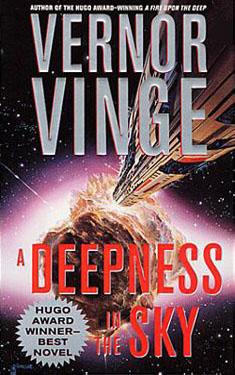
Book Review: A Deepness in the Sky

Ok, so I have been more than absent on the blog over the last few months . . . end of school and even more importantly, getting the house ready for our new little baby. Walter Jack Burgener was born on June 1st and has been keeping mom and dad busy ever since. But, over the next few days I'll try and gear up to start  writing again. Anyways, to kind of get the writing juices flowing I thought I'd do a quick review of a book I just finished reading (credit to Jesse for getting me hooked on this series in the first place). So, on to the review:
________________________________________________________________________________

This book is fantastic.

Vernor Vinge is probably most well known for an earlier hard science fiction novel A Fire Upon the Deep, a galaxy-spanning tale of super-bright AI gods who interact with "regular" men and women via mortal avatars. A Deepness in the Sky is a pseudo-prequel that details the earlier adventures of one of these avatars, a man named Pham Nuwen, who in AFUD (hehe, great acronym) was used almost like a puppet by a super-bright AI. A Deepness in the Sky takes place thousands of years earlier on the other side of the galaxy and deep within the "Slow Zone" where futuristic technologies like faster-than-light travel and nanomachines are an impossibility.


At the start of the story, Pham Nuwen is an old man who has been trying--across dozens of start systems and several relative millenia--to create an enduring human empire out of the Queng Ho, space-faring traders who visit nearly every corner of human space.

A Queng Ho fleet picks Pham up from an out-of-the-way star system where he'd been marooned and heads for one of the last great mysteries in human space--the On-Off star, a variable sun with a single orbiting planet. For centuries humanity has monitored this enigmatic system and the radio signals that stream from the planet. It is the first evidence of a technologically advanced alien species ever found, and the Queng Ho race towards the distant world with dreams of unimaginable discoveries . . . and equally unimaginable profits stemming from those discoveries.

Too bad they're not the only kids on the block. They arrive at the On-Off system at nearly the same time as a second human fleet shows up--the militaristic Emergents are a relatively new civilization, and at first the two fleets feign friendship and attempt to work together; however, a sneak attack by the Emergents leaves both fleets crippled and only a handful of both communities alive. Their only hope of survival is to wait year after year in the coldness of space while the aliens on the planet below develop an industrial civilization capable of rebuilding the human ships.

Ok, thats enough of spoilers . . . the rest of the book takes off from that point and doesn't let up until the final page.

True to Vinge's style, the aliens, or "Spiders" as the humans call them, are amazingly rendered. We see the Spiders both from their own point of view, and from the human's point of view, which allows the reader to experience the aliens as true extraterrestrials, and as normal beings living normal lives on their normal planet. This juxtaposition is only heightened towards then end of the book when the two species finally make contact.

Like AFUD, A Deepness in the Sky is short on true military action, but nevertheless includes a lot of action sequences that leave you breathless, especially towards the end. In fact, this story probably has more action than AFUD, though a lot of it is the type of fighting that we'd be more familiar with--the Spider nations go through several warring periods, beginning with a global war reminiscent of both WWI and WWII, a decidedly Cold War and then a final war that could have come straight from a Tom Clancy novel . . . something that our world, thankfully, has managed to avoid so far.

There are dozens of characters with their own story arcs--both human and Spider, but Pham Nuwen was definitely my favorite. I don't think I've ever met a character who was so good and yet had such terrible plans for humanity. His actions and machinations really drive the whole story.

Now, I don't wanna give the whole story away, but there are a few things that Vinge nailed that I gotta mention:

  1. Keeping the science real . . . Vinge has created a compelling story with lots of action and excitement without breaking any of the rules of physics (as we know them, of course)
  2. Alien aliens . . . the Spiders are weird, and perhaps weirder by the end of the book because at first they don't seem all that weird. Heh, how many times can I use the word weird?
  3. Timelessness . . . . Vinge creates a world full of amazing technology, but manages to be just vague enough about specific machines and functions that the story isn't dated like so many old classic sci-fi stories.
Anyways, I'll end this little post by giving A Deepness in the Sky ten thumbs way way up (yeah, thats how many thumbs your average Spider would have). In fact, this story is so good I would actually recommend reading it before A Fire Upon the Deep. In my opinion that'd make both stories more enjoyable.

Later . . .

Monday, February 28, 2011

Something worth reading

This is a fun short story written by Eric James Stone, probably one of the most prominent short story writers in the country. He was also at LTUE and is an all around nice guy. This is his nebula nominated (hopefully the winner) story for this year. I personally loved it.


http://www.ericjamesstone.com/blog/stories/that-leviathan-whom-thou-hast-made/

Saturday, February 19, 2011

Book Review: Leviathan

How long has it been since you guys have found a book that you literally couldn't put down? For me, its been quite a while. The Way of Kings didn't do it for me. Not even Towers of Midnight. In fact, I think the last book I read that kept me up past my bedtime was Vernor Vinge's A Fire Upon the Deep, which I read at least two years ago. Well, Scott Westerfeld's Leviathan definitely upset my two-year run of good nights' sleep. And he did it in under 80,000 words.


Leviathan is a dieselpunk alternate history, set in Europe on the day the Archduke Ferdinand was assassinated in Sarejevo. On the one side we have the Central powers: Germany, Austro-Hungary and the Ottoman Empire; collectively known as 'Clankers' because of their mighty walkers, airships and other machines. On the other side we have the Triple Entente: Great Britain, France and Russia; called 'Darwinists' in this world, a name they've earned by manipulating the 'life-threads' (read DNA) of animals to create giant creatures of war, living counterparts to the Clankers' dreaded war machines.

Caught in the middle of this brewing war are two unlikely friends: Aleksander, the son of the Archduke and secret heir to the Hapsburg throne and Deryn, a girl posing as a boy in the Royal Air Navy.

For the sake of avoiding any spoilers I'll stop the plot re-hash now. Just take my word for it, the pace is fast, the action masterfully executed, the dialogue witty and fluid, and the characters as real as they come. But the thing that I really loved about this book was exploring the striking contrasts and similarities between Westerfeld's book and true history.

I'll admit that there was one point on which I disagreed with the professional reviewers. Most of them made some kind of comment or another about the ingenious language Westerfeld had invented to go along with his Clanker and Darwinist creations. Well . . . other than Clanker, Darwinist and actually naming some of the man-made Darwinist creatures, I think Westerfeld only added in maybe a half dozen new words. Fun, but hardly noteworthy.

All in all, I would recommend Leviathan to anyone looking for a good read, regardless of what type of fiction they're interested in. I'm already halfway through the sequel Behemoth and hungry for the final installment, Goliath.

Go Clankers!

(ok, ok . . . I've always had a soft spot for the big machines . . .)

Friday, January 14, 2011

I cannot tell a lie

Hey folks! I promised to post 500 words a week, but my stories are kinda spinning their wheels at present, so I might be posting miscellanea for a while. On the other hand, that means you don't have to commit to a sustained reading of my stuff (at least not yet!) The following is a short essay about a book I just read, In Bed with the Word, a book about reading by Daniel Coleman.  I thought it might be interesting for people who read as much as we do.

I'm looking for any general proofreading issues (they way it's worded, spelling or grammar mistakes, etc.) but mostly in your reaction to the ideas.  I wrote the piece more or less under the assumption that people would know the book I'm talking about, but I want to know if it's clear to someone who hasn't read the book what I'm talking about.

If the essay is clear enough, what motivates you to read in general and science fiction and fantasy in specific?

I figure a conversation about reading is good for us, since we all intend someone else to read what we've written and if we understand why people read, perhaps we can write to better motivate people to read our stuff.  :)


     To my American mindset, the counterculture is essentially supposed to consist of “make peace, not war,” and “drugs, sex, and rock and roll.” But for a long time I have been unsettlingly amused by the way that “the man” has domesticated these supposedly independent aspects of American culture and made a pretty dollar in its distribution. I know I have often felt a strong social pressure to accept counterculture values as my own and to conform to accepted forms of nonconformity in dress, speech, music, and philosophy. I fear that counterculture has been transformed from liberator to conquistador, leaving it devoid of positive social impact. As an accepted norm, countercultural values can deny individuality just as readily as the values against which they rebelled.
     The primary value of counterculture is its willingness to question the accepted norms of society. As John Stuart Mill argues in On Liberty, this allows a culture to develop, whether or not a counterculture’s ideas are truer than the accepted norm: even largely fallacious arguments contain part of the truth, and even if they have nothing to offer, they prove the importance of the accepted argument. Counterculture is necessary if a society wants to avoid calcification and obsolescence. The conflict between establishment and dissent breathes life into a society and gives it direction as it works out the debate. But when the counterculture becomes the establishment, it is difficult to understand how to dissent against dissention and the function of questioning may be lost for a time.
     Against the incessant pace of technology’s march and the restless pull of consumer culture, Coleman recommends that an important countercultural activity is simply reading. Surrounded by electronic stimulus that gives us no rest and seems inescapably accompanied by the insistent demand that we consume more and think less, reading is inherently in opposition to the accepted norms. “Reading is counter-cultural mainly because it requires quiet time, being slow and meditative, and it is active rather than passive” (26). Coleman goes on to say that of course not all books are constructive and not all electronic media are destructive, but that as a general rule reading, by its meditative nature, provides a greater opportunity for spirituality and creativity. I would say that it allows us to act more and be acted upon less, liberating us from a state of subjection to other things and allowing us to develop an independent perspective.
     Coleman highlights another essential aspect of reading as counterculture: the dual application of the hermeneutics of suspicion and the hermeneutics of affirmation. Western culture has widely accepted the application of the hermeneutics of suspicion, creating an orthodoxy of skepticism. This has been, in my opinion, a powerful tool for social development as a means of dismantling unjust power structures and enfranchising the oppressed. When applied correctly, it should also to some extent free us from the grip of consumer culture as we approach advertising with skepticism. But I agree with Coleman that in absence of the hermeneutics of affirmation, the hermeneutics of suspicion can erode spiritual development by disallowing humility. “Spirituality assumes that I have something to learn and that I can learn it from the many things around me that draw me out of myself” (39) Coleman writes, but an all-pervasive suspicion undermines my ability to approach anything with the humility required to learn. In this way, reading – which requires humility and even vulnerability before the text in order to be done properly – gives an opportunity to pursue the hermeneutics of affirmation and develop a counterculturally positive perspective.

Works cited.
Coleman, Daniel. In Bed with the Word. Edmonton: Univ. Alberta Press, 2009. Print.

Tuesday, January 4, 2011

Book Review: The Wheel of Time Book XIII - Towers of Midnight

All right . . . since nobody else (ehem, Travis and Colton) seems to want to do a review of Towers of Midnight, I guess I will. This will be an interesting review, cause its been about seven weeks since I put the book down, so my impressions of the book have had time to . . . um, marinate? Anyways, feel free to disagree or agree . . . and please, if you do feel strongly about anything I say . . . comment on it. I wanna hear what you guys thought of this book.

Oh, and warning . . . I've been reading Wheel of Time for so long now that I basically have no way of knowing whether or not I'm giving a spoiler or not. Reader beware.

So, Towers of Midnight.


The hard thing about commenting on Towers of Midnight is the sheer bulk of material that precedes it. Its nearly impossible to detach it from the rest of series and look at it as its own work . . . and you really wouldn't want to. Another problem is that not only are we comparing a new book to the 12 that precede it, but we're also comparing a new author to Robert Jordan. So, I'll try and give you a quick run through of my feelings about the book, and then go back through and look at a few things in more detail.

The first question I probably need to answer is how does Towers of Midnight rank against the rest of the series? I guess that would depend on which books you personally liked the best. For me, Towers of Midnight was probably on par with The Gathering Storm, The Fires of Heaven and Lord of Chaos, and nearly as good as the first four books of the series. It was definitely better than books seven through ten . . . and the jury is still out about how I feel about Knife of Dreams.

Second question: how did Brandon Sanderson do? And its a mixed answer . . . Sanderson is a great author, and I think that The Gathering Storm and Towers of Midnight alone would have secured him a place as one of the great fantasy authors of the  . . . what century are we in now? But we can't look at the two books alone, we have to compare them to the eleven books that Robert Jordan left us. In Towers of Midnight, I think Sanderson writes both more and less like Robert Jordan than he did in the Gathering Storm. Allow me to explain: I came away from the Gathering Storm stunned by the story, but a little disappointed with some of the characters; especially (you guessed it) Mat. Towers of Midnight had the reverse effect on me. Sanderson nailed each of the characters (yes, including Mat) and even managed to make me like Perrin again. However, the arc of the story didn't feel like a Jordan book--it was definitely a Sanderson. There was a lot of jumping between POV's, even in the middle of a chapter, which was something Jordan largely avoided. It also felt like Sanderson embellished things that Jordan would have skipped over, and skipped over things Jordan would have embellished. Let me repeat: amazing writing, but different than Jordan. And what more could you expect, honestly?


The thing I liked the most about Towers of Midnight was that it pushed the plot forward, resolving dozens of questions and story arcs, and bringing in a whole new crop of questions. The thing I disliked the most about Towers of Midnight was that a lot of the question-resolutions felt rushed . . . very rushed. For example, I was expecting the whole Mat and the Tower of Ghenjei story arc to consume at least a third of the book. Instead, it took up barely an entire chapter . . . I wanted more. Instead of feeling like a traditional fantasy quest, it felt more like a quick midnight run to Wal Mart . . . only cooler, I guess. The whole Bell-founder and Dragons story arc felt very hurried as well. Mat has been trying to get these canons made ever since Winter's Heart . . . and we've basically known he was going to do it since, um . . . The Dragon Reborn. And yet, after several books of build up, he gets the whole project done in a little over two chapters. And Rand meeting Egwene felt rushed as well. Again, feel free to disagree with me, but thats how it seemed.

Now for some more nitty-gritty things. I thought that Sanderson handled the One Power very well in The Gathering Storm, keeping it true to Robert Jordan's description of the Power, and writing some very cool scenes with it (e.g. Egwene defending the White Tower from the Seanchan). In Towers of Midnight, he seems to have deviated a bit more from Jordan's use of the Power. For example, the scene where Graendal somehow puts herself into the mind of a dove seemed a bit out of place in a Wheel of Time book. I can't exactly put my thumb on why, except that we've never seen anything remotely like that in any of the other books. Compared to some of the other uses the Forsaken have put the One Power to over the course of the series, this seemed . . . simplistic? Contrived? I'm not sure, but it definitely seemed out of place.

Another moment that felt different was when Rand walks down from Dragonmount and magically heals the farmer's apple orchard. Now, I didn't mind this scene as much, because it was from a simple farmer's point of view, so I suppose the One Power really would seem all mystical and stuff . . . its just that during the rest of the series (except maybe the first few chapters of Eye of the World) we only see the One Power used either through the eyes of men and women who can control it, or through the eyes of people who are well aquainted with Aes Sedai and what-not. So having an entire orchard suddenly bloom to life with no description of what weaves were used, or which parts of the Power, or even just how freaking difficult it was to do seemed . . . different.

Now, lest you think I hated the book, let me tell you what I liked:

Perhaps what I liked best about Towers of Midnight was the fact that the war has finally begun. I mean really, if you think about it, we haven't seen a large scale human vs. Trolloc battle since the fourth book, The Shadow Rising. Yeah, they've appeared every once and a while (Fires of Heaven and, um . . . Knife of Dreams?) but not like they did in the first three books. I've missed them. For the bulk of the series, we've just only seen men fighting men, and that sparingly (Battle of Cairhien, Dumai's Wells, Rand vs. the Seanchan, anything else?). The whole scene in the prologue where the border towers are over run was incredibly compelling. The Battle of Maradon had me giggling with excitement. It was awesome . . . and it gave me great hope for what we'll find in A Memory of Light.

Sanderson saved Mat's character in Towers of Midnight. I think the whole problem with Mat in The Gathering Storm was his humor. I didn't mind that he was suddenly a writer, or that he was comfortable helping Aes Sedai like Verin. It was just his jokes that bugged me. It was like I wasn't reading Mat, but Kelsier from Mistborn, and it really interrupted the story for me each time he whipped out another quick pun. Well, Towers of Midnight solved all of that. Mat was back in true form, mouthing off to the Queen of Andor, joking around with his men and just generally griping about everything. Oh, and when they're in the Tower of Ghenjei, he's the definitely the old Mat we know and love, taunting the snakes and foxes just like he used to.

Luckily, Mat isn't the only great character. The Gathering Storm took Rand by the scruff of his neck and dragged him through the gutter . . . repeatedly. When we finally see Rand again inTowers of Midnight, he has metamorphosed into a new man, becoming at once the old Rand from the first four (maybe five) books and fully (finally) the Dragon Reborn, Lew Therin Telamon. He was awesome (and a little freaky) through the entire book, staring the Amyrlin Seat down and single handedly wiping out an entire army of Trollocs. Bring on the Last Battle.

Okay, I think I've said about everything that can be said for Towers of Midnight, except one last thing: Perrin. Perrin was beyond awesome, and was hands-down the best part of Towers of Midnight. Now, I should admit that for most of the series Perrin was my favorite character, so I'm a little biased. I loved his chapters in the first four books more than any others, but basically since the end of Lord of Chaos, he hasn't done much of anything. His story arc seemed to wander just as much as he did, dragging us through what, like three books of looking for his wife? The final battle between his army and the Shaido was cool, but it took FOREVER to get there. Through all of that, I (and many others) started to wonder just what the heck Perrin was there for. Rand was obviously the Dragon Reborn, and Mat had a clear purpose: be an awesome general and develop gun powder. We could at least see where those two were headed. But Perrin . . . Perrin just kind of meandered. But not anymore. I won't say how or what, but just take my word for it . . . he has once again been crowned Best Character Ever.

In summary, Towers of Midnight felt less like a Jordan than The Gathering Storm, and much more like a Sanderson. Despite this, I wouldn't hesitate in saying that its one of the best books of the series (top six, maybe?) and well worth the read

Bring on the Last Battle.

Please.

No really, we've waited long enough.
Tuesday, October 5, 2010

Book Review: The Way of Kings

If you guys are anything like me, you're often on the hunt for a new book to read. The problem I have is that I'm a pretty picky reader, and I tend to put down most things I pick up. So I thought it'd be a good idea to start a new Book Review thread going here on the blog. Any time you guys read a book you like, or hate, feel free to post a review of the book up here on the blog . . . It'll help the rest of us find stuff we wanna read. If you do post a review, just give it the label 'Book Reviews', that way we can find all of them pretty easily. Oh, and avoid spoilers, when possible.

So, The Way of Kings:


*Disclaimer: you'll notice that I compare The Way of Kings to the Eye of the World a lot. I know that might seem unfair, or strange, but the Eye of the World was the only 1st-in-a-series book that I've read that contained similar scope and depth. So, um, deal with it . . .

What can I say about this book in general? First off, its big. Scratch that. Huge. I finally put it down last night having read all 1008 (or something like that) pages. I can't think of any other fantasy series that has started off with a book that big. At a thousand pages, its three hundred pages longer than Eye of the World . . . in fact, its as long or longer than any of the Wheel of Time books. So if you have a hankering to read it, know that you are picking up a big, big book.

Brandon Sanderson has made a name for himself among the fantasy community for two things: ingenious magic systems and big plot twists that came late in the book. The Way of Kings lives up to both of these expectations, but not in the way I was expecting. Don't worry, I'll explain.

The magic he introduces in The Way of Kings is vast and complex . . . more so than in any other fantasy book I have ever read. Making a quick count, I think he reveals four, possibly five distinct magic magic systems during the course of the novel, each one was unique and incredibly fascinating. However, unlike in Mistborn, where Sanderson lays out the rules of the magic in a clear, concise way, the magic in The Way of Kings is more, well, mystical. There is still more explanation of the magic than you'd find in the Lord of the Rings (which has basically no explanation) but a whole lot less than he gave us in Mistborn or Warbreaker. For one of the magic systems he introduces there is probably about as much explanation as Robert Jordan gives the One Power in the Wheel of Time. For the rest, you get even less. Overall, I really enjoyed this approach to magic, even more than I enjoyed his explanations in Mistborn and Warbreaker. But, like I said, it was definately not what I was expecting.

Now, as far as for plot twisters, The Way of Kings definately lives up to expectations. But for me, this was both a strength and weakness. The bulk of the Way of Kings was definately not a page turner. In fact, it wasn't until I hit page 950 that I had that "Oh my heck I can't put this book down" feeling. But the feeling did hit me, it just took a lot of work getting there. So, the plot twist thing worked, because the end definately was unexpected, and exciting.

But, here's why I also think its a weakness: I think that most fantasy authors, even most High Fantasy authors, don't plan on their series being more than three or four books long. There's the famous quote from Robert Jordan: "It'll be a trilogy" and even George R.R. Martin only planned his series to be four or five books long, in the beginning (I'm not sure what he's planning now). Sanderson, however, went into this series telling the world it was going to be ten books long (I shudder to think what'll happen if he tries to emulate Jordan's ever expanding series thing . . . can you image a 30 book series of 900 page novels?) Well, if you're gonna expect people to invest a big chunk of their time into reading a 10 book series, you'd better start the series off with a real zinger. And The Way of Kings was not a zinger. It didn't read like the first book in a series, in fact, it read more like the seventh book in a series. Sanderson saved his punches (and they were big, awesome punches) for the last 100 pages of the book, but it felt like he should have been delivering punches right from the beginning . . . and he didn't.

When you settle down to read the Way of Kings, be prepared for a huge cast of characters. The Eye of the World is told from the perspective of 5 characters (and the vast majority of the story is from the perspective of just 1 character). I don't have an exact count, but in the Way of Kings you get a POV from nearly 15 different characters, with the bulk of the story being told from the POV of 3 different characters. Spreading the story out between so many different characters made for an interesting read, but it also made The Way of Kings feel less like the opening book of a series. Even halfway into the book I found myself struggling to remember who certain side-characters were. Add to this the fact that one character's storyline jumps back and forth in time, and you have a very complex story.

And although the characters in the Way of Kings are incredibly interesting, varied and well written, the sheer number of them made me come away from the story feeling like I hadn't gotten to know any one of them as well as you know Rand by the end of the Eye of the World.

The world Sanderson created for The Way of Kings is amazing in both its creativity and its depth; but, if you're looking for a classical fantasy world of deep forests and high, snow-capped mountains, this is definately not it. Roshar is an alien place, hard rock devoid of soil and few plants or animals that we would recognize. Instead, it is filled with a plethora of crab- and lobster-like animals of all shapes and sizes, and plants that are more like the corals and sponges you'd find in an ocean reef. Roshar doesn't feel like Bag End.

I found the setting of The Way of Kings both fascinating, and a little disorienting. I had opened the book prepared to read a fantasy, but I could never quite shake the feeling that what I was reading was actually science fiction in disguise. It was interesting to explore this new world . . . but this isn't High Fantasy in the grand old tradition.

To sum it up, The Way of Kings was worth all the time I spent reading it, but it definitely was work getting to the good stuff. I stood in line on opening night to get a signed copy, and for the first 500 or so pages I was regretting that decision. Now that I've finished the book, I don't regret it at all, and I plan on staying up late to get the sequel next year, and I'd definitely recommend it to anyone.

Brandon Sanderson is at the forefront of a new generation of fantasy writers, and he's definitely good at what he does. But for all its delicious goodness, I set down The Way of Kings feeling a little let down. There was just something missing from this first novel in the Stormlight Archive, something that I'd found in Tolkien, Jordan and Eddings. Sanderson's world was just a little too alien, his magic a little too polished. In the past decade, fantasy has taken a bold step forward, led in large part by Sanderson. But for me, that bold step forward has taken fantasy a long way from what made it special in the beginning.

The genre is in danger of losing the magic that gave it birth.

Later . . .