Just read this over on Tor. Really great little piece.
Later . . .
Wednesday, July 13, 2011
Tuesday, July 12, 2011
World Building - Weapon Styles
Alright, here's some world building notes for you to feast your eyes on. That is if anyone actually reads it. I wanted to do something for fighting styles that was more than what was normally seen. Rather than follow WoT's method of naming every single technique of using a sword, I wanted to fall back into an actual style of fighting, rather than a method of moving a sword.
I used the 7 light-saber forms from Star Wars as a basis and expanded it from there. The idea is that these weapon forms are applicable with any weapon, not just a sword (although some styles work better or worse with certain weapons).
All fighting styles draw their roots from ancient Sylthanian techniques,. Through the ages, the fighting styles have altered and changed, and new forms are created to answer weaknesses or strengths in others.
The techniques of these fighting styles began once with a group of swordmasters in Aquitamar. A common trial practice was Trial by Combat, where the accused and the accuser select champions to fight for them. In Aquitamar, these fights were never to the death, but instead to first yield. Eventually small groups of fighters began to hone their dueling skills to the point that they began the de facto champions used in Trial by Combat. They gained the name Arbites, and even though most nations do not use Trial by Combat, the name has extended to anyone with sufficient skill.
The path to becoming an Arbite is a long one, and involves multiple amounts of tests, duels, and training. Only when several Arbites cast a vote to the affirmative can one join their ranks, and gain the facial tattoo of their preferred fighting form. Those caught using a fake tattoo are killed on sight.
There are five styles. Three originally were created by Sylthanians, those being Tornado, Avalanche, and Iron Shield. Celestials developed the Entropic style, and Torton invented the Zephyr style. Each is generally strong against one style and weak against another.
THE ZEPHYR STYLE
The Zephyr’s Style is the most recent style, generated in Torton roughly a century ago. It is a style of fighting designed for gentleman's dueling, as well as close range fighting in narrow quarters. It demands maneuverability and superior footwork and position, developing the Arbite's mastery of swift parries and thrusts designed to whittle an opponent down and tire them out. When it comes to sheer control of a fight, there are no better Arbites than Zephyrs.
Strong Against
The Entropic Style. The Entropic style relies on the Arbite being chaotic and aggressive yet even chaos can be predicted and outmaneuvered by a Zephyr. They use the Entropic's aggression against them, taking advantage of the lack of defense the opposing style offers.
Weak Against
The Avalanche Style -The Arbite's strength is also a weakness. it relies on maneuverability and control, and as a result, the Zephyr's attacks hold little to no momentum while the Avalanche relies on relentless assaults, pummeling aside the Zephyr's defenses.
Practitioners
Nobleman, politicians, Prelate Sargoth, Mozsha mon Altern
THE IRON SHIELD STYLE
The Iron Shield Style is one of the original forms. It relies on keeping a close guard with your weapon, concentrating on defense, while your opponent tires themselves out in their assault. Iron Shields are the epitome of patience as they observe their opponent style, and move in for the kill when weakness presents itself.
Strong Against
The Avalanche Style—The Iron Shield will calmly deflect every blow by the Avalanche as they maintain their defense. Where the Zephyr relies on cunning and manipulation to defend, the Iron Shield will use any opportunity to turn an opponent's blade away, letting them match an Avalanche's intensity.
Weak Against
The Tornado Style—The Iron Shield relies on keeping a close guard, and of letting their opponent come to them, but a Tornado uses their acrobatic styles and extended reach to bypass the Shield’s guard at a distance to penetrate their defenses.
Practitioners
Bodyguards,Those who are neither fast nor especially strong, pacifists, Alda Zacari
THE ENTROPIC STYLE
The Entropic Style was the first style invented after the original three. It was developed by Bladejudges of the Celestial Empire as a method to defeat the whirlwind Tornados that scissored through soldiers while maintaining no true weakness of their own.
The Entropic Style relies on a chaotic and frenzied attack, often divesting ones self of any defense instead creating an unstoppable attack. The Entropic believes the best defense is a good offense, and will seek to end a fight as quickly as possible.
Strong Against
The Tornado Style-The Entropic Style constantly aims assaults and attacks at the Tornado, putting them into a defensive position. They seize any opportunity to strike, depriving the agile Tornados of their maneuverability.
Weak Against
The Zephyr Style—The Zephyr was developed as a counter-measure against Entropics. While the Entropics are maddening in assault, the Zephyr uses the Entropic’s momentum against them and and unbalances them. Where no defense can be found, the Zephyr will know.
Practitioners
Speaker Eztli, Bladejudges, Cosmic mages
THE TORNADO STYLE
The Tornado Style is an original form. It was developed as a counter measure to defensive Iron Shields. The Tornado fights often in whirlwind attacks, extending their blades out to maximize reach. This leaves them vulnerable to disarms, but free from the fear of retaltion that a closer style might bring.
It is the most acrobatic of all styles, and demands dexterity and athleticism to fight properly. When done correctly, the Tornado becomes just like their namesake, a blur of spiraling motion.
Strong Against
The Iron Shield Style—The Iron Shield's close guard, and lack of counter-attacks leave them vulnerable to fighting from an extended range. The Tornado seeks to maneuver around the Iron Shield, breaking their defenses.
Weak Against
The Entropic Style—The Entropic Style's relentless assaults keep the Tornado on the defensive. Entropics use their own offense to counter the offense of the Tornado, ultimately breaking them down.
Practitioners
Short people, agile people, Fists, Celestial Tayshi Tenoch, Joshi Fitaru Jazalai
THE AVALANCHE STYLE
The Avalanche’s style is misnamed. The word avalanche bestows thoughts of rough and ragged and uncontrolled. To see an avalanche in combat is to see the innate beauty of a storm. They fight in an assault of brute force attacks combined with single-minded determination, pummeling their opponents.
The Avalanche is best at overpowering an individual through sheer tenacity, and Avalanches are renown for for their relentless assaults.
Strong Against
The Zephyr’s Style - The Zephyr relies on grace and precision to turn an opponent’s attacks away. The Avalanches overpowers the Zephyr, by constantly hammering at their defense, maintaining powerful kinetic blows that unbalance the Zephyr.
Weak Against
The Iron Shield—The Iron Shield’s techniques are the answer to the Zephyrs' Weakness. While the Zephyr seeks to redirect the motions of a Avalanche, the Iron Shield seeks to block them. The Shield’s own methods rely on more fully engaging the Avalanche, and keeping up momentum.
Practitioners
Strong people, high constitution/endurance people, Haylo Qaanir
I used the 7 light-saber forms from Star Wars as a basis and expanded it from there. The idea is that these weapon forms are applicable with any weapon, not just a sword (although some styles work better or worse with certain weapons).
All fighting styles draw their roots from ancient Sylthanian techniques,. Through the ages, the fighting styles have altered and changed, and new forms are created to answer weaknesses or strengths in others.
The techniques of these fighting styles began once with a group of swordmasters in Aquitamar. A common trial practice was Trial by Combat, where the accused and the accuser select champions to fight for them. In Aquitamar, these fights were never to the death, but instead to first yield. Eventually small groups of fighters began to hone their dueling skills to the point that they began the de facto champions used in Trial by Combat. They gained the name Arbites, and even though most nations do not use Trial by Combat, the name has extended to anyone with sufficient skill.
The path to becoming an Arbite is a long one, and involves multiple amounts of tests, duels, and training. Only when several Arbites cast a vote to the affirmative can one join their ranks, and gain the facial tattoo of their preferred fighting form. Those caught using a fake tattoo are killed on sight.
There are five styles. Three originally were created by Sylthanians, those being Tornado, Avalanche, and Iron Shield. Celestials developed the Entropic style, and Torton invented the Zephyr style. Each is generally strong against one style and weak against another.
THE ZEPHYR STYLE
The Zephyr’s Style is the most recent style, generated in Torton roughly a century ago. It is a style of fighting designed for gentleman's dueling, as well as close range fighting in narrow quarters. It demands maneuverability and superior footwork and position, developing the Arbite's mastery of swift parries and thrusts designed to whittle an opponent down and tire them out. When it comes to sheer control of a fight, there are no better Arbites than Zephyrs.
Strong Against
The Entropic Style. The Entropic style relies on the Arbite being chaotic and aggressive yet even chaos can be predicted and outmaneuvered by a Zephyr. They use the Entropic's aggression against them, taking advantage of the lack of defense the opposing style offers.
Weak Against
The Avalanche Style -The Arbite's strength is also a weakness. it relies on maneuverability and control, and as a result, the Zephyr's attacks hold little to no momentum while the Avalanche relies on relentless assaults, pummeling aside the Zephyr's defenses.
Practitioners
Nobleman, politicians, Prelate Sargoth, Mozsha mon Altern
THE IRON SHIELD STYLE
The Iron Shield Style is one of the original forms. It relies on keeping a close guard with your weapon, concentrating on defense, while your opponent tires themselves out in their assault. Iron Shields are the epitome of patience as they observe their opponent style, and move in for the kill when weakness presents itself.
Strong Against
The Avalanche Style—The Iron Shield will calmly deflect every blow by the Avalanche as they maintain their defense. Where the Zephyr relies on cunning and manipulation to defend, the Iron Shield will use any opportunity to turn an opponent's blade away, letting them match an Avalanche's intensity.
Weak Against
The Tornado Style—The Iron Shield relies on keeping a close guard, and of letting their opponent come to them, but a Tornado uses their acrobatic styles and extended reach to bypass the Shield’s guard at a distance to penetrate their defenses.
Practitioners
Bodyguards,Those who are neither fast nor especially strong, pacifists, Alda Zacari
THE ENTROPIC STYLE
The Entropic Style was the first style invented after the original three. It was developed by Bladejudges of the Celestial Empire as a method to defeat the whirlwind Tornados that scissored through soldiers while maintaining no true weakness of their own.
The Entropic Style relies on a chaotic and frenzied attack, often divesting ones self of any defense instead creating an unstoppable attack. The Entropic believes the best defense is a good offense, and will seek to end a fight as quickly as possible.
Strong Against
The Tornado Style-The Entropic Style constantly aims assaults and attacks at the Tornado, putting them into a defensive position. They seize any opportunity to strike, depriving the agile Tornados of their maneuverability.
Weak Against
The Zephyr Style—The Zephyr was developed as a counter-measure against Entropics. While the Entropics are maddening in assault, the Zephyr uses the Entropic’s momentum against them and and unbalances them. Where no defense can be found, the Zephyr will know.
Practitioners
Speaker Eztli, Bladejudges, Cosmic mages
THE TORNADO STYLE
The Tornado Style is an original form. It was developed as a counter measure to defensive Iron Shields. The Tornado fights often in whirlwind attacks, extending their blades out to maximize reach. This leaves them vulnerable to disarms, but free from the fear of retaltion that a closer style might bring.
It is the most acrobatic of all styles, and demands dexterity and athleticism to fight properly. When done correctly, the Tornado becomes just like their namesake, a blur of spiraling motion.
Strong Against
The Iron Shield Style—The Iron Shield's close guard, and lack of counter-attacks leave them vulnerable to fighting from an extended range. The Tornado seeks to maneuver around the Iron Shield, breaking their defenses.
Weak Against
The Entropic Style—The Entropic Style's relentless assaults keep the Tornado on the defensive. Entropics use their own offense to counter the offense of the Tornado, ultimately breaking them down.
Practitioners
Short people, agile people, Fists, Celestial Tayshi Tenoch, Joshi Fitaru Jazalai
THE AVALANCHE STYLE
The Avalanche’s style is misnamed. The word avalanche bestows thoughts of rough and ragged and uncontrolled. To see an avalanche in combat is to see the innate beauty of a storm. They fight in an assault of brute force attacks combined with single-minded determination, pummeling their opponents.
The Avalanche is best at overpowering an individual through sheer tenacity, and Avalanches are renown for for their relentless assaults.
Strong Against
The Zephyr’s Style - The Zephyr relies on grace and precision to turn an opponent’s attacks away. The Avalanches overpowers the Zephyr, by constantly hammering at their defense, maintaining powerful kinetic blows that unbalance the Zephyr.
Weak Against
The Iron Shield—The Iron Shield’s techniques are the answer to the Zephyrs' Weakness. While the Zephyr seeks to redirect the motions of a Avalanche, the Iron Shield seeks to block them. The Shield’s own methods rely on more fully engaging the Avalanche, and keeping up momentum.
Practitioners
Strong people, high constitution/endurance people, Haylo Qaanir

Sunday, July 10, 2011
Descent of the High Families of Greater Amar
Ok, so this is mostly to prove (to myself?) that, contrary to popular belief, I have been working on stuff. Now, the work I've been doing is all worldbuilding, but thats ok, cause I enjoy it :)
So, this is a (as yet incomplete) genealogy showing how most of the main characters in my fantasy story can ultimately trace their family lines back to a common ancestor.
95% of the nobility in Amar claim descent through some branch of this family tree . . . whether or not the claim is true or not.
More will come during the week.
Later . . .
So, this is a (as yet incomplete) genealogy showing how most of the main characters in my fantasy story can ultimately trace their family lines back to a common ancestor.
95% of the nobility in Amar claim descent through some branch of this family tree . . . whether or not the claim is true or not.
More will come during the week.
Later . . .
Thursday, June 16, 2011
Tuesday, June 14, 2011
Another Sci-Fi Link
Ok, so here's another Hard-SF link. Orion's Arm is a collaborative world-building group that has built a huge universe that tries as hard as possible to be scientifically accurate (as far as we understand the physics and such at the moment).
This link is to their encyclopedia area where you can browse around. I like it, cause if you're ever wondering how an antimatter drive would work, you can look it up here with fairly high confidence that the explanation you'll get is accurate.
Enjoy!
Later . . . .
This link is to their encyclopedia area where you can browse around. I like it, cause if you're ever wondering how an antimatter drive would work, you can look it up here with fairly high confidence that the explanation you'll get is accurate.
Enjoy!
Later . . . .
Monday, June 13, 2011
Three if by Air
Alright, here is the next piece I'm working on turning in for Writers of the Futre. I wish that I had gotten it on here more recently, but I've been sort of busy and kep forgetting. Well here it is. Some of you might already have it, and some of you might not. Either way, here is the first bit of it, so let me know. I'm not looking for any sort of specific feedback, just overall thoughts, typos, plot holes, etc.
Three if by Air
One if by land, two if by sea, three if by air. I repeated the mantra until it became a meaningless drone in my head. There was nothing special about this litany, yet the words danced across my mind like a catchy tavern tune. My eyes darted from the North Church, to the HMAS Somerset moored above Boston Harbor, to the deserted streets of Boston itself. The only illumination originated from the airship’s deck lamps where sentries watched from their lofty perch for the few brave souls who dared to break General Gage’s curfew.
Brave or foolhardy. Paul Revere claimed his signal would occur the moment he had an answer. I doubted his plan would proceed that simply. Light the lanterns, and cross the bay, Madeline. We’ll be out before the lobsters know what’s happening. A daring sentiment considering Gage’s standing order to shoot anyone suspected of running messages out of the city. I remained wary all the same. My job was just to hold the iron horse while he crossed. Doctor Warren’s orders on behalf of the Committee of Public Safety. Paul was the more reliable rider, so he got the hard work. Me? I got paid either way.
I glanced to the silent machine. It looked as much like a horse as a doll looked like a baby. The legs, head and body held a similar position and orientation, but regular horses weren’t filled with steel joints, hydraulic pistons, and covered in exhaust vents protruding from every angle. The animal—the machine—was still as a statue, not similar to a real horse in the slightest.
A dog in Boston barked, and I flinched, my eyes flickering towards the church. No signal. What’s taking so long? By the time on my chronometer, the Regulars should have begun their march fifteen minutes ago. Paul’s contacts in the Regulars were reliable enough to confirm that information. General Gage had given orders to leave Boston tonight. They intended on heading to Lexington, most likely to arrest the Patriot leaders there.
Most had since fled the city. If the gossip was to be believed, John Hancock, my former employer, as well as fiery Samuel Adams hid somewhere nearby to coordinate resistance, but I couldn’t confirm that rumor. No one ever told me anything. War is not a woman’s business. How many other women have risen to helmsman on a merchant ship? Fought in a duel with three men at once and won? Not damn many.
The HMAS Somerset lit up, interrupting my diatribe. The decklights on the airship created a new star in the night. Men called to each other, each an unintelligible vocalization coming from far above. My eyes went to the church. Nothing. Did they see Paul? His crossing might not go unnoticed.
I shifted uncomfortably where I stood at the edge of Charleston. A person out at night with an iron horse, an illegal piece of machinery, would raise eyebrows. A woman out an night with an iron horse demanded an explanation. I stilled my breathing to listen as the lights and voices dulled away. No, just the changing of the guard. I sighed in relief.
One if by land, two if by sea, three if by air. The mantra relaxed me for some reason. Any of those choices were likely. The Regulars might take the land route, or they might cross the harbor. Either meant Lion Knights. The great mechanical-armored Regulars would be slow moving, but would have the momentum of a runaway wagon. Nothing would stop them.
But if the Regulars traveled by air, they’d arrive at their destination and meet no resistance, having left the ground bound militia behind. The iron horses were there in that event. They ate fuel like a Hessian at dinnertime, but when comparing their speed to a dirigible’s, the dirigible might as well be at a standstill.
Revere’s signal occurred with such subtlety, that in my focused state I almost missed it. A light in the tower. Another. Then a third. The lights lasted half a heartbeat. The Regulars would move by air. That left me waiting for Paul. His favor, owed to him from a year back.
I paced back and forth, trying to busy my mind and stop worrying. Other riders would already be leaving from the city. William Dawes, Paul’s partner in crime had no doubt left from southern Boston. He was but one of several insurance policies against the Regular’s intervening in our warnings. The signal from the tower was a beacon to several other riders in nearby villages to begin the warning. They already must be well on their way out.
Voices came again from the Somerset. In the darkness, I spied movement on the airship’s railing. Another changing of the guard? Fear crept up like a lion stalking its prey. The Somerset’s foglights still lay unmanned, but there was movement on deck. Hand-held blue gas lamps shifted from position to position marking the movement of the watchmen.
Hurry it up, Paul. I watched the opposite shore for any signs of the man. The glows still moved about the deck above me, but I couldn’t make out their activities. Another voice called out, the wind carrying it to my ears as an incomprehensible whisper.
I heard a splash, too powerful to be a wave, too light to be unintentional. I locked onto the opposite shoreline. Another splash. A tiny brown shape slowly manifested into a lone figure riding low in a boat. Paul Revere. He sat alone in the small boat, accompanied by nothing else but the wind and the silence of the night.
From my vantage point his direction of travel suggested a landing a half-mile to the north. I grabbed the dangling harness of the iron horse and pulled. It fell into step behind me with slave-like obedience.
Anxiety fluttered inside me like a bee inside a jar. I’d misjudged Paul’s landing. The current was pulling Paul farther north. Right towards the Somerset. His flurried attempts to correct his course showed he wasn’t oblivious to the danger. He plunged his oars in, each stroke pushing him farther from the imposing airship.
The foglights on the Somerset exploded into life. If the earlier lights were a new star, this was a new sun. The cascades of illumination began to scope out the bay, highlighting every part of the harbor. Relax; they might be just performing a random sweep in the bay for smugglers. I knew this wasn’t the case. Just a little further. They hadn’t spotted Paul yet.
Despite his efforts, Paul drifted closer and closer to the shadow of the airship. The spotlights roamed the water, each a predator looking for prey. Revere stilled and dropped into the boat, freezing as the lights crept closer. I held my breath. The lights slinked by fewer than ten feet from where Paul sat.
Then they were gone, off to explore other parts of the bay. Paul dipped the oars into the murky water. I looked at the iron horse, and missed what happened next. One minute he was rowing across the bay and the next, he floundered about in the water next to his capsized boat.
Before I could move, the foglights were back, each an eye from heaven glaring down at Paul, now within fifteen feet of the shoreline. Their intent was clear. The rata-tat of the repeating rifles mounted on the deck of the Somerset drowned out Paul’s frantic attempts to stay afloat. I bolted for the water’s edge, abandoning the iron horse.
The lights spotted me as well, but I welcomed their gaze. Each glow brightened my path to the shore and Paul. The guns continued to howl out terrifying bursts that rocketed both water and dirt into the air, splattering me with both. I arrived just as Paul floundered onto shore, looking more like a drowned jester than a drowned rat. He collapsed but my arms shot out, grabbing him to stop his fall. Without waiting for him to speak, I gripped him under the shoulders, and dragged him to the woods. The strength to pull him came surprisingly easy, no doubt due to the adrenaline coursing through my body. Bullets continued to spray around us, yet by some miracle, none hit us. As I came into the canopy, the shots tapered off, leaving the sounds of shouting from the Somerset to fill the air.
As I dragged, I laughed aloud, as I couldn’t help but think of what my father would say. Grabbing a man and dragging him into the woods? That wasn’t how he had raised his only daughter. I’d been the mistress to the Marquis Caulaincourt a decade ago, and was now on British controlled colonies, working with the Colonials. He’d die of heart failure when he heard.
The thought of my blustery old father collapsing was humorous, but the mirth faded as I considered my situation. Ground troops would arrive any moment and mirth would be the last emotion on their mind.
I gently set Paul down next to several red maples. He groaned as I patted him down and my hands came away red. I wiped them across the trees, while I thought. Shot, at least twice. For all my various skills, I did not count medicine or surgery among them. Charleston had a doctor. But I can’t take him there. That’s the first place the Regulars would look. They’d find him immediately, and haul him back to jail for questioning. If he survives the night.
“Madeline…” Paul gasped.
“Stay silent, you’ll be fine,” I said.
“You’re a lousy liar. I can’t finish this now. You take the horse.”
“Nonsense. You need a doctor, man.”
I tore off a section of his shirt, and wrapped it around the bullet wound in his lower torso. I knew I needed to bandage his wounds, but beyond that, I was unsure what needed to be done.
“Damn it, girl. You can’t do anything for me now. Every minute you waste—” his words cut short as he coughed like a plague victim.
“Fine, I’ll do it, just stay still and—“
He cleared his throat. “Get out of here. I’m calling in another favor. Everything is counting on you. You’ll find help in Lexington. Look for a large double story gray-green house with nine windows on the front. I’ll be fine.”
I began to speak, but he let out another cacophony of coughs, and then went still. I sat for a moment, shocked. I looked to my yet again bloodstained fingers and wiped them on a nearby tree. Just like that he was dead. I stood, still looking down at him. He was alive and then he wasn’t, as easy as blinking your eyes. I knew what I needed to do. I always paid my debts and kept my promises. Paul lay peacefully, uncaring of the world around me. Promises to a dead man. I turned and didn’t look back.
Several moments passed before I found the abandoned iron horse. With such an odd framework, you’d think it would be easy to find, but a motionless machine at the edge of the forest in the middle of night is hard to spot.
I jumped to the saddle and slid my hands into the saunters. My arms and wrists hung loosely inside the oversized controls, obviously meant for larger hands. I de-activated the automatic-slave; the setting that told it to follow harness tugs, and took manual control.
The machine shifted with the motion of my arms and stumbled several steps. Only internal balance systems kept it from falling to the ground. I hadn’t used one in years, not since me and Johann Hammer were together. I recalled us both astride stolen iron horses, running across the countryside of northern Europe.
I, the eager young student, and he the wise teacher, showing me how to sing, fight, and think. He changed my life over three years, but our relationship didn’t last, and he remained in Europe, while I left for the colonies. Like him or not, the gruff Hessian mercenary certainly changed Monsieur Dautier’s daughter.
I leaned my shoulders forward and the machine took several steps in response. I leaned even more and it sped up. The memories of using the iron horse slowly came back to me, as if I had ridden just yesterday. I leaned into the saunters and the machine shot away, quickening to an intense speed that threatened to steal my breath. Given its state of ill-repair, it moved with surprising ease, racing at least four times as fast as the quickest horse.
The world around me became a blur of passing trees, and the road melded into a gray stream flowing beneath me. I focused onto the road and only the road. If my concentration wavered for a brief moment, I’d run into a tree. I was unfortunate enough to witness the result of such an incident and it was an outcome I wished to avoid.
The wind on my face was exhilarating and I embraced the flow, relishing the speed. I suddenly realized I was ignoring my original purpose. There was a promise to keep. The road on which I traveled curved to the north, passing by several unfamiliar villages before shifting south to join the main road towards Lexington.
Already up ahead, I saw a village coming into view around the leaves and branches of the forest. I brought the iron horse down to q slower speed, worried I might send the villages into a panic when I stormed through their town like a thunderbolt.
I stopped into the square and the iron horse fell silent as it awaited my next command. I switched it into automatic-slave setting and dismounted, looking about my surroundings. Large buildings of new construction rose around me, each belching smoke into the sky as their furnaces burned coal for the inhabitants. Their nearness to Boston meant cheap goods, as shown by the coal furnaces, the gas lamps, and various other technologies.
As expected, my arrival did not go unnoticed, and I had scarcely taken four steps before blue glows were flickering on inside the village.
I first thought to knock on a door, but I knew that if I just waited, the locals would come to me. Warnings regarding possible Regular movements against the Colonists already permeated the countryside and the villages only needed a catalyst—myself—to dispatch the militia. As I waited, I became aware of a low rumbling. I looked to the sky, imagining a storm on the move, but the air was empty save for the bright stars.
I looked back towards Boston, hoping to spot the airships. Nothing sat in the sky. No imposing shapes or amorphous airships hovered in the sky. I almost looked away when I saw a star eclipse behind a shape.Intently I watched the spot, and another vanished. There. Two airships. Easily a mile up if not more. They were so high, I couldn’t even hear the low drone of their engines, and their shapes were illusive shadows that one would miss unless they already knew where to look.
“Regulars are on the move,” said a voice behind me. I nearly jumped, but part of me kept my nerve and I faced my guest.
One if by land, two if by sea, three if by air. I repeated the mantra until it became a meaningless drone in my head. There was nothing special about this litany, yet the words danced across my mind like a catchy tavern tune. My eyes darted from the North Church, to the HMAS Somerset moored above Boston Harbor, to the deserted streets of Boston itself. The only illumination originated from the airship’s deck lamps where sentries watched from their lofty perch for the few brave souls who dared to break General Gage’s curfew.
Brave or foolhardy. Paul Revere claimed his signal would occur the moment he had an answer. I doubted his plan would proceed that simply. Light the lanterns, and cross the bay, Madeline. We’ll be out before the lobsters know what’s happening. A daring sentiment considering Gage’s standing order to shoot anyone suspected of running messages out of the city. I remained wary all the same. My job was just to hold the iron horse while he crossed. Doctor Warren’s orders on behalf of the Committee of Public Safety. Paul was the more reliable rider, so he got the hard work. Me? I got paid either way.
I glanced to the silent machine. It looked as much like a horse as a doll looked like a baby. The legs, head and body held a similar position and orientation, but regular horses weren’t filled with steel joints, hydraulic pistons, and covered in exhaust vents protruding from every angle. The animal—the machine—was still as a statue, not similar to a real horse in the slightest.
A dog in Boston barked, and I flinched, my eyes flickering towards the church. No signal. What’s taking so long? By the time on my chronometer, the Regulars should have begun their march fifteen minutes ago. Paul’s contacts in the Regulars were reliable enough to confirm that information. General Gage had given orders to leave Boston tonight. They intended on heading to Lexington, most likely to arrest the Patriot leaders there.
Most had since fled the city. If the gossip was to be believed, John Hancock, my former employer, as well as fiery Samuel Adams hid somewhere nearby to coordinate resistance, but I couldn’t confirm that rumor. No one ever told me anything. War is not a woman’s business. How many other women have risen to helmsman on a merchant ship? Fought in a duel with three men at once and won? Not damn many.
The HMAS Somerset lit up, interrupting my diatribe. The decklights on the airship created a new star in the night. Men called to each other, each an unintelligible vocalization coming from far above. My eyes went to the church. Nothing. Did they see Paul? His crossing might not go unnoticed.
I shifted uncomfortably where I stood at the edge of Charleston. A person out at night with an iron horse, an illegal piece of machinery, would raise eyebrows. A woman out an night with an iron horse demanded an explanation. I stilled my breathing to listen as the lights and voices dulled away. No, just the changing of the guard. I sighed in relief.
One if by land, two if by sea, three if by air. The mantra relaxed me for some reason. Any of those choices were likely. The Regulars might take the land route, or they might cross the harbor. Either meant Lion Knights. The great mechanical-armored Regulars would be slow moving, but would have the momentum of a runaway wagon. Nothing would stop them.
But if the Regulars traveled by air, they’d arrive at their destination and meet no resistance, having left the ground bound militia behind. The iron horses were there in that event. They ate fuel like a Hessian at dinnertime, but when comparing their speed to a dirigible’s, the dirigible might as well be at a standstill.
Revere’s signal occurred with such subtlety, that in my focused state I almost missed it. A light in the tower. Another. Then a third. The lights lasted half a heartbeat. The Regulars would move by air. That left me waiting for Paul. His favor, owed to him from a year back.
I paced back and forth, trying to busy my mind and stop worrying. Other riders would already be leaving from the city. William Dawes, Paul’s partner in crime had no doubt left from southern Boston. He was but one of several insurance policies against the Regular’s intervening in our warnings. The signal from the tower was a beacon to several other riders in nearby villages to begin the warning. They already must be well on their way out.
Voices came again from the Somerset. In the darkness, I spied movement on the airship’s railing. Another changing of the guard? Fear crept up like a lion stalking its prey. The Somerset’s foglights still lay unmanned, but there was movement on deck. Hand-held blue gas lamps shifted from position to position marking the movement of the watchmen.
Hurry it up, Paul. I watched the opposite shore for any signs of the man. The glows still moved about the deck above me, but I couldn’t make out their activities. Another voice called out, the wind carrying it to my ears as an incomprehensible whisper.
I heard a splash, too powerful to be a wave, too light to be unintentional. I locked onto the opposite shoreline. Another splash. A tiny brown shape slowly manifested into a lone figure riding low in a boat. Paul Revere. He sat alone in the small boat, accompanied by nothing else but the wind and the silence of the night.
From my vantage point his direction of travel suggested a landing a half-mile to the north. I grabbed the dangling harness of the iron horse and pulled. It fell into step behind me with slave-like obedience.
Anxiety fluttered inside me like a bee inside a jar. I’d misjudged Paul’s landing. The current was pulling Paul farther north. Right towards the Somerset. His flurried attempts to correct his course showed he wasn’t oblivious to the danger. He plunged his oars in, each stroke pushing him farther from the imposing airship.
The foglights on the Somerset exploded into life. If the earlier lights were a new star, this was a new sun. The cascades of illumination began to scope out the bay, highlighting every part of the harbor. Relax; they might be just performing a random sweep in the bay for smugglers. I knew this wasn’t the case. Just a little further. They hadn’t spotted Paul yet.
Despite his efforts, Paul drifted closer and closer to the shadow of the airship. The spotlights roamed the water, each a predator looking for prey. Revere stilled and dropped into the boat, freezing as the lights crept closer. I held my breath. The lights slinked by fewer than ten feet from where Paul sat.
Then they were gone, off to explore other parts of the bay. Paul dipped the oars into the murky water. I looked at the iron horse, and missed what happened next. One minute he was rowing across the bay and the next, he floundered about in the water next to his capsized boat.
Before I could move, the foglights were back, each an eye from heaven glaring down at Paul, now within fifteen feet of the shoreline. Their intent was clear. The rata-tat of the repeating rifles mounted on the deck of the Somerset drowned out Paul’s frantic attempts to stay afloat. I bolted for the water’s edge, abandoning the iron horse.
The lights spotted me as well, but I welcomed their gaze. Each glow brightened my path to the shore and Paul. The guns continued to howl out terrifying bursts that rocketed both water and dirt into the air, splattering me with both. I arrived just as Paul floundered onto shore, looking more like a drowned jester than a drowned rat. He collapsed but my arms shot out, grabbing him to stop his fall. Without waiting for him to speak, I gripped him under the shoulders, and dragged him to the woods. The strength to pull him came surprisingly easy, no doubt due to the adrenaline coursing through my body. Bullets continued to spray around us, yet by some miracle, none hit us. As I came into the canopy, the shots tapered off, leaving the sounds of shouting from the Somerset to fill the air.
As I dragged, I laughed aloud, as I couldn’t help but think of what my father would say. Grabbing a man and dragging him into the woods? That wasn’t how he had raised his only daughter. I’d been the mistress to the Marquis Caulaincourt a decade ago, and was now on British controlled colonies, working with the Colonials. He’d die of heart failure when he heard.
The thought of my blustery old father collapsing was humorous, but the mirth faded as I considered my situation. Ground troops would arrive any moment and mirth would be the last emotion on their mind.
I gently set Paul down next to several red maples. He groaned as I patted him down and my hands came away red. I wiped them across the trees, while I thought. Shot, at least twice. For all my various skills, I did not count medicine or surgery among them. Charleston had a doctor. But I can’t take him there. That’s the first place the Regulars would look. They’d find him immediately, and haul him back to jail for questioning. If he survives the night.
“Madeline…” Paul gasped.
“Stay silent, you’ll be fine,” I said.
“You’re a lousy liar. I can’t finish this now. You take the horse.”
“Nonsense. You need a doctor, man.”
I tore off a section of his shirt, and wrapped it around the bullet wound in his lower torso. I knew I needed to bandage his wounds, but beyond that, I was unsure what needed to be done.
“Damn it, girl. You can’t do anything for me now. Every minute you waste—” his words cut short as he coughed like a plague victim.
“Fine, I’ll do it, just stay still and—“
He cleared his throat. “Get out of here. I’m calling in another favor. Everything is counting on you. You’ll find help in Lexington. Look for a large double story gray-green house with nine windows on the front. I’ll be fine.”
I began to speak, but he let out another cacophony of coughs, and then went still. I sat for a moment, shocked. I looked to my yet again bloodstained fingers and wiped them on a nearby tree. Just like that he was dead. I stood, still looking down at him. He was alive and then he wasn’t, as easy as blinking your eyes. I knew what I needed to do. I always paid my debts and kept my promises. Paul lay peacefully, uncaring of the world around me. Promises to a dead man. I turned and didn’t look back.
Several moments passed before I found the abandoned iron horse. With such an odd framework, you’d think it would be easy to find, but a motionless machine at the edge of the forest in the middle of night is hard to spot.
I jumped to the saddle and slid my hands into the saunters. My arms and wrists hung loosely inside the oversized controls, obviously meant for larger hands. I de-activated the automatic-slave; the setting that told it to follow harness tugs, and took manual control.
The machine shifted with the motion of my arms and stumbled several steps. Only internal balance systems kept it from falling to the ground. I hadn’t used one in years, not since me and Johann Hammer were together. I recalled us both astride stolen iron horses, running across the countryside of northern Europe.
I, the eager young student, and he the wise teacher, showing me how to sing, fight, and think. He changed my life over three years, but our relationship didn’t last, and he remained in Europe, while I left for the colonies. Like him or not, the gruff Hessian mercenary certainly changed Monsieur Dautier’s daughter.
I leaned my shoulders forward and the machine took several steps in response. I leaned even more and it sped up. The memories of using the iron horse slowly came back to me, as if I had ridden just yesterday. I leaned into the saunters and the machine shot away, quickening to an intense speed that threatened to steal my breath. Given its state of ill-repair, it moved with surprising ease, racing at least four times as fast as the quickest horse.
The world around me became a blur of passing trees, and the road melded into a gray stream flowing beneath me. I focused onto the road and only the road. If my concentration wavered for a brief moment, I’d run into a tree. I was unfortunate enough to witness the result of such an incident and it was an outcome I wished to avoid.
The wind on my face was exhilarating and I embraced the flow, relishing the speed. I suddenly realized I was ignoring my original purpose. There was a promise to keep. The road on which I traveled curved to the north, passing by several unfamiliar villages before shifting south to join the main road towards Lexington.
Already up ahead, I saw a village coming into view around the leaves and branches of the forest. I brought the iron horse down to q slower speed, worried I might send the villages into a panic when I stormed through their town like a thunderbolt.
I stopped into the square and the iron horse fell silent as it awaited my next command. I switched it into automatic-slave setting and dismounted, looking about my surroundings. Large buildings of new construction rose around me, each belching smoke into the sky as their furnaces burned coal for the inhabitants. Their nearness to Boston meant cheap goods, as shown by the coal furnaces, the gas lamps, and various other technologies.
As expected, my arrival did not go unnoticed, and I had scarcely taken four steps before blue glows were flickering on inside the village.
I first thought to knock on a door, but I knew that if I just waited, the locals would come to me. Warnings regarding possible Regular movements against the Colonists already permeated the countryside and the villages only needed a catalyst—myself—to dispatch the militia. As I waited, I became aware of a low rumbling. I looked to the sky, imagining a storm on the move, but the air was empty save for the bright stars.
I looked back towards Boston, hoping to spot the airships. Nothing sat in the sky. No imposing shapes or amorphous airships hovered in the sky. I almost looked away when I saw a star eclipse behind a shape.Intently I watched the spot, and another vanished. There. Two airships. Easily a mile up if not more. They were so high, I couldn’t even hear the low drone of their engines, and their shapes were illusive shadows that one would miss unless they already knew where to look.
“Regulars are on the move,” said a voice behind me. I nearly jumped, but part of me kept my nerve and I faced my guest.
Sunday, June 12, 2011
Book Review: A Deepness in the Sky
Ok, so I have been more than absent on the blog over the last few months . . . end of school and even more importantly, getting the house ready for our new little baby. Walter Jack Burgener was born on June 1st and has been keeping mom and dad busy ever since. But, over the next few days I'll try and gear up to start writing again. Anyways, to kind of get the writing juices flowing I thought I'd do a quick review of a book I just finished reading (credit to Jesse for getting me hooked on this series in the first place). So, on to the review:
________________________________________________________________________________
 This book is fantastic.
Vernor Vinge is probably most well known for an earlier hard science fiction novel A Fire Upon the Deep, a galaxy-spanning tale of super-bright AI gods who interact with "regular" men and women via mortal avatars. A Deepness in the Sky is a pseudo-prequel that details the earlier adventures of one of these avatars, a man named Pham Nuwen, who in AFUD (hehe, great acronym) was used almost like a puppet by a super-bright AI. A Deepness in the Sky takes place thousands of years earlier on the other side of the galaxy and deep within the "Slow Zone" where futuristic technologies like faster-than-light travel and nanomachines are an impossibility.
At the start of the story, Pham Nuwen is an old man who has been trying--across dozens of start systems and several relative millenia--to create an enduring human empire out of the Queng Ho, space-faring traders who visit nearly every corner of human space.
A Queng Ho fleet picks Pham up from an out-of-the-way star system where he'd been marooned and heads for one of the last great mysteries in human space--the On-Off star, a variable sun with a single orbiting planet. For centuries humanity has monitored this enigmatic system and the radio signals that stream from the planet. It is the first evidence of a technologically advanced alien species ever found, and the Queng Ho race towards the distant world with dreams of unimaginable discoveries . . . and equally unimaginable profits stemming from those discoveries.
Too bad they're not the only kids on the block. They arrive at the On-Off system at nearly the same time as a second human fleet shows up--the militaristic Emergents are a relatively new civilization, and at first the two fleets feign friendship and attempt to work together; however, a sneak attack by the Emergents leaves both fleets crippled and only a handful of both communities alive. Their only hope of survival is to wait year after year in the coldness of space while the aliens on the planet below develop an industrial civilization capable of rebuilding the human ships.
Ok, thats enough of spoilers . . . the rest of the book takes off from that point and doesn't let up until the final page.
True to Vinge's style, the aliens, or "Spiders" as the humans call them, are amazingly rendered. We see the Spiders both from their own point of view, and from the human's point of view, which allows the reader to experience the aliens as true extraterrestrials, and as normal beings living normal lives on their normal planet. This juxtaposition is only heightened towards then end of the book when the two species finally make contact.
Like AFUD, A Deepness in the Sky is short on true military action, but nevertheless includes a lot of action sequences that leave you breathless, especially towards the end. In fact, this story probably has more action than AFUD, though a lot of it is the type of fighting that we'd be more familiar with--the Spider nations go through several warring periods, beginning with a global war reminiscent of both WWI and WWII, a decidedly Cold War and then a final war that could have come straight from a Tom Clancy novel . . . something that our world, thankfully, has managed to avoid so far.
There are dozens of characters with their own story arcs--both human and Spider, but Pham Nuwen was definitely my favorite. I don't think I've ever met a character who was so good and yet had such terrible plans for humanity. His actions and machinations really drive the whole story.
Now, I don't wanna give the whole story away, but there are a few things that Vinge nailed that I gotta mention:
________________________________________________________________________________
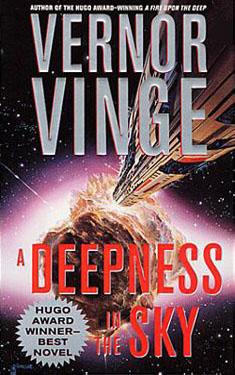
Vernor Vinge is probably most well known for an earlier hard science fiction novel A Fire Upon the Deep, a galaxy-spanning tale of super-bright AI gods who interact with "regular" men and women via mortal avatars. A Deepness in the Sky is a pseudo-prequel that details the earlier adventures of one of these avatars, a man named Pham Nuwen, who in AFUD (hehe, great acronym) was used almost like a puppet by a super-bright AI. A Deepness in the Sky takes place thousands of years earlier on the other side of the galaxy and deep within the "Slow Zone" where futuristic technologies like faster-than-light travel and nanomachines are an impossibility.
At the start of the story, Pham Nuwen is an old man who has been trying--across dozens of start systems and several relative millenia--to create an enduring human empire out of the Queng Ho, space-faring traders who visit nearly every corner of human space.
A Queng Ho fleet picks Pham up from an out-of-the-way star system where he'd been marooned and heads for one of the last great mysteries in human space--the On-Off star, a variable sun with a single orbiting planet. For centuries humanity has monitored this enigmatic system and the radio signals that stream from the planet. It is the first evidence of a technologically advanced alien species ever found, and the Queng Ho race towards the distant world with dreams of unimaginable discoveries . . . and equally unimaginable profits stemming from those discoveries.
Too bad they're not the only kids on the block. They arrive at the On-Off system at nearly the same time as a second human fleet shows up--the militaristic Emergents are a relatively new civilization, and at first the two fleets feign friendship and attempt to work together; however, a sneak attack by the Emergents leaves both fleets crippled and only a handful of both communities alive. Their only hope of survival is to wait year after year in the coldness of space while the aliens on the planet below develop an industrial civilization capable of rebuilding the human ships.
Ok, thats enough of spoilers . . . the rest of the book takes off from that point and doesn't let up until the final page.
True to Vinge's style, the aliens, or "Spiders" as the humans call them, are amazingly rendered. We see the Spiders both from their own point of view, and from the human's point of view, which allows the reader to experience the aliens as true extraterrestrials, and as normal beings living normal lives on their normal planet. This juxtaposition is only heightened towards then end of the book when the two species finally make contact.
Like AFUD, A Deepness in the Sky is short on true military action, but nevertheless includes a lot of action sequences that leave you breathless, especially towards the end. In fact, this story probably has more action than AFUD, though a lot of it is the type of fighting that we'd be more familiar with--the Spider nations go through several warring periods, beginning with a global war reminiscent of both WWI and WWII, a decidedly Cold War and then a final war that could have come straight from a Tom Clancy novel . . . something that our world, thankfully, has managed to avoid so far.
There are dozens of characters with their own story arcs--both human and Spider, but Pham Nuwen was definitely my favorite. I don't think I've ever met a character who was so good and yet had such terrible plans for humanity. His actions and machinations really drive the whole story.
Now, I don't wanna give the whole story away, but there are a few things that Vinge nailed that I gotta mention:
- Keeping the science real . . . Vinge has created a compelling story with lots of action and excitement without breaking any of the rules of physics (as we know them, of course)
- Alien aliens . . . the Spiders are weird, and perhaps weirder by the end of the book because at first they don't seem all that weird. Heh, how many times can I use the word weird?
- Timelessness . . . . Vinge creates a world full of amazing technology, but manages to be just vague enough about specific machines and functions that the story isn't dated like so many old classic sci-fi stories.
Anyways, I'll end this little post by giving A Deepness in the Sky ten thumbs way way up (yeah, thats how many thumbs your average Spider would have). In fact, this story is so good I would actually recommend reading it before A Fire Upon the Deep. In my opinion that'd make both stories more enjoyable.
Later . . .
Saturday, May 14, 2011
Busy busy
In case you haven't heard, I've been busy. My Geology 410 class is a massive demand on my time, and I've had little free time. In addition, I've lost much of my will to edit my current Writers of the Future draft, but I'm trying to finish the edits.
It's mostly the critical side of my brain ends up dead after so much work and I have little desire to edit anything, and instead wish to work on other projects. Given that I'm a completionist, I have to finish this project and only then can I move onto other stuff. I suppose the desire to work on my complete overhaul of Architect of Legends will motivate me to work faster.
Feel free to look by my blog for some writing that I have done in the meantime. I hope to finish this WotF draft by the end of this coming week, but given all likelihood, expect it the week after that.
In the meanwhile, Landon, I know you were wanting to read that second draft of Illusions of Control so here it is.
https://docs.google.com/leaf?id=0B24LU75HbwPPOGNhNTk5MGEtZmNkZi00ZmIzLThkMDEtYmY1Y2YyNzU4MjU4&hl=en&authkey=CNqOh5AB
It's mostly the critical side of my brain ends up dead after so much work and I have little desire to edit anything, and instead wish to work on other projects. Given that I'm a completionist, I have to finish this project and only then can I move onto other stuff. I suppose the desire to work on my complete overhaul of Architect of Legends will motivate me to work faster.
Feel free to look by my blog for some writing that I have done in the meantime. I hope to finish this WotF draft by the end of this coming week, but given all likelihood, expect it the week after that.
In the meanwhile, Landon, I know you were wanting to read that second draft of Illusions of Control so here it is.
https://docs.google.com/leaf?id=0B24LU75HbwPPOGNhNTk5MGEtZmNkZi00ZmIzLThkMDEtYmY1Y2YyNzU4MjU4&hl=en&authkey=CNqOh5AB
Wednesday, May 4, 2011
Everything you need to know about making a spaceship
 Howdy folks,
Just thought I'd post a link up right here to the Atomic Rockets website that gives lots of technical information about spaceships and space combat. Its a sweet site, very informative, but only if you're interested in writing science fiction that leans more to the "hard" (read: plausible) side of the spectrum.
Later . . .
Wednesday, April 6, 2011
WotF Outline - Three if by Air
Alright, people have probably noted that I haven't been submitting stuff. This is not due to boredom on my part, but due to me working on outlines and worldbuilding. Here is the outline for my next WotF entry.
Firstly, this is an outline, not writing. It is present tense, third person omnipotent. It gives the story synopsis in telling format. It is not meant to be entertaining, but is to give the dynamics of the story and tell the plot, characters, resolution, etc.
Questions:
1. Did you see any plot holes? Put another way, do I raise questions and never answer them? This isn't about world building questions, but actual plot resolution.
2. How are the characters? Are they interesting? Do they seem invested in the plot, in each other?
3. How does the setup sound? Do you see any logical pieces missing? This means questions like "Why don't the characters just do X" or "Why are they doing X when it won't work?
4. Anything else. This is an outline, so I don't care about the actual writing. I'm looking at content.
Three if by Air Outline 2
Background
April, 1775. The colonies are at an uneasy standing with Britain as the Crown levies more unfair taxes and treaties against the unruly Colonials. Boston is held under military rule by General Gage, as he tries to destroy the hotbed of revolutionary activity taking shape in the Americas. The Patriots, the leaders of the opposing faction, have fled to Pennsylvania, leaving only Samuel Adams and John Hancock in Boston.
Fearing tyrannical British ordinances, many colonists have stockpiled weapons, preparing for the fight they see as inevitable. The British are wildly unpopular. General Gage, knowing that Sam Adams and John Hancock are in close proximity, discovers the colonists are hording weapons outside of Boston, in the city of Concord.
With this knowledge in hand, Lord Gage orders the Regulars to seize the weapon caches as well as arrest Adams and Hancock if the opportunity presents itself. The Patriots are also aware of British orders to march, and messengers await the sign that the British have mobilized and are marching.
Unbeknownst to the British, the Benjamin Franklin currently in Britain, is not the real Ben Franklin. The real one along with several Patriots setup a workshop in Massachusetts, near Concord, away from prying eyes. Franklin is building a new mechanical armor, one that doesn’t require a man to operate. His hopes and the hopes of the people helping him is that the weapon will be a deterrent and the British will back down. Unfortunately for Franklin, the British have become aware from a loyalist spy that the Patriots have a workshop somewhere in the forests near Concord, where they are making something dangerous.
Characters
Montgomery McCullough
Monty has been a business partner with John Hancock for some time, dealing with the smuggling in Boston, under the nose of the British. Born an urchin on the streets of the same city, he worked his way into the docks business. He was able to succeed largely because of his discerning ability to find patterns and know the right thing to say at the right time.
A house fire some years back severely burned his left hand, and he now keeps the maimed digits wrapped in a bandage. The house fire claimed the lives of both his wife and young son of six. Or at least so he thought. During the fire he was injured trying to go back in after them, and was held back by concerned neighbors. The son was rescued by another man who ran in to help.
The tremendous blaze destroyed several buildings, and in the confusion father and son were separated. Monty thought the boy dead, and the boy was given to the orphanage when no father could be found. Subsequently adopted, Monty only found out the son lived five years later. He has begun watching the boy, giving him gifts or helping him behind his back. He doesn’t want to break the emotional wounds open. His son already lost his father. Regaining him would be just as bad.
With problems like that, Monty has less patience for the Patriotic fervor of his friends. He is in the business to get money, and though not dishonest, he does have a reputation for being financially tight-fisted. He is neither loyalist nor patriot, but he has a growing dislike of the British with each new tax making it harder for him to do his job. He is a man respected by his peers, known as someone who keeps his word, and does the work asked of him. He is also a very well known gambler, and has an enviable lucky streak.
Monty finds himself pushed into a cause that was someone else’s, and is forced to find just whose side he is on, and whether he is simply staying away from his son for his son’s sake, or for his own.
John Hancock
The smuggler (it is not blatantly stated, but implied) and patriot is a man who is unashamed of what he believes in, and forceful in speaking and personality. He has money, and he has contacts. He is someone who knows what he wants and then pursues it for whatever he can get out of it.
He is remaining near Boston largely because he refuses to be kept out of the fight. He is a man who is not afraid of getting into the thick of things, and almost has a fearless edge to his personality. He is with Samuel Adams, planning issues against the British when the Regulars leave Boston.
He is zealous and good mannered. He is unafraid and yet knows fear. He is charming in his own way, yet he has a personality which beckons to mind someone who will get what they want every single time.
Benjamin Franklin
The Renaissance man who is Benjamin Franklin is one who is calm and collected, yet becomes a dragon when upset. He is always quipping when he speaks, and has an overbearing personality that will blow people away. He gets his head lost in his work sometimes, but he is no bumbling scientist.
Under the guise of going to England to negotiate treaties and fair treatment for the colonies, an imposter was appointed to pretend to be Franklin. Instead, the real Franklin with the blessing of rich Patriot patrons began work in a lab near Boston on a machine.
The strength of the British has always lied in their disciplined soldiers, as well as in their Lion Knights, the soldiers wearing the mechanical armor and act as Britain’s heavy guns. Franklin plans on achieving a true automaton Lion Knight, that will tell the British that the colonies can take care of themselves as well as leave a Damocles sword over the Crown so that they know the colonists will not be backed into a corner.
His work is nearly completed, and soon he will have made the world’s first automatic soldier, a being who does not fear, needs no food, nor rest. With it, he hopes to create a new revolution and create a utopia for men. He is not aware that the British are coming, and when they find it, they’ll have their own purposes for the automaton.
Plot
Montgomery McCullough sits in Charleston holding the keys to an iron horse. He repeats the mantra, “One if by land, two if by sea, three if by aAir,” awaiting the signal from the Old North Church to signal the departure of the British. Everyone suspects the British to travel by air, but some think they might try sneaking their soldiers out via land or sea.
He is there not out of any sense of patriotism, but because he was asked by Paul Revere. Revere knows that Monty is a man of his word, and called in a favor owed by Monty to wait for him Charleston while he crosses the bay on a normal horse. Monty sees the signal. As expected, the British are traveling by air, hoping to catch the Patriots off guard.
Monty sees a boat crossing the bay. He knows this is Revere, trying to sneak past HMAS Somersat which sits moored nearby. Just as Revere is about to make it, the Somersat spots him, and, under orders to open fire at any messengers, shoots at him. Revere stumbles ashore, bleeding out. In his last moments, he convinces Monty to take his place and warn the countryside. He tells him to head to a certain address at Lexington and he’ll find people who can help him.
Revere asks, “When was the last time you saw your son?”
Monty says, “Three days.”
“You should talk to him. A son should know his father,” Revere says and then he dies.
Monty, having made a promise, gets on the iron horse, a familiar steed, and tears off into the countryside, arriving at Mystic. There, he awakes the commander for the militia, and gives the warning out. Already, the British movements are becoming obvious as the great airships fill the sky. The militia warned, Monty continues towards Lexington.
On his travels, he encounters a patrol of British regulars (two men), who immediately discern he is a messenger. They try to detain him, but he breaks away, relying on his own knowledge of the terrain to escape. He warns every house he comes across until he hits the main road near Pierce’s Hill. He finds he is behind William Dawes, one of the other riders, and so he heads straight for Lexington, passing by roused Militia.
Upon arrival, he seeks the address Revere gave him, and knocks at the door. He is pulled inside at gunpoint, and asked to identify himself. He tells and there is murmured discussion before he is allowed to see his captors. Monty is surprised to discover himself among the presence of Samuel Adams, John Hancock (his business partner), as well as the other main rider, William Dawes.
Monty finds the group is preparing the militia to resist the British, even as the sounds of airships fill the air. The Patriots were initially under the impression the British were to arrest them, but they realize that the amount of manpower deployed is too great to just arrest them, and the Regulars must be after the weapon cache in Concord.
“Or worse,” Hancock says, as he casts an uneasy gaze at Adams.
They tell Monty that whether he wants to or not, he’s now officially part of the conspiracy.
“Welcome aboard. Membership fees are due in a week!” Hancock laughs.
Monty is told that things are better left shown than told, as to just what could be worse. Hancock was already adamant about being close to the action, so they agree for Adams to head to another safe house, while Dawes and Prescott continue to Concord. Hancock is instructed to take Monty to “the project” since there needs to be a warning there as well.
While they are riding, the two reminisce about old times together, smuggling different supplies past the British during the past few years. Hancock talks about Monty’s son, and tells him he really needs to talk to the kid. Their conversation continues for a moment until they run into another blockade of British Regulars, these ones mounted on iron horses rather than real ones. The blockade forces them to stop, and their owning two iron horses raise more than one suspicious eye.
As they are awkwardly answering questions by the Regulars, Hancock gives Monty the signal, and they both bolt for freedom. The startled Regulars give chase, realizing that the two are messengers.
A sudden gap in the trail, and a swift Regular force the pair to split up, and Monty finds himself in a desperate chase through the forest with two Regulars hot on his trail, trying to subdue him. They fire their guns at his horse, trying to damage the machine and dismount him.
((Find some interesting way to shake off his pursuers? Either through mechanical knowledge, or knowledge of the environment?) He finished the chase, having lost his pursuers. However his iron horse, long since having lost much of its fuel, collapses.
Monty gets up, and realizes he doesn’t know where he is. He sets off to find the road, which he does, and follows it in a westward direction.
He sees a barn and stops there to check and look for directions as well as warn the inhabitants of the regular’s procession. The dirigibles are still some distance behind him. He knocks, and the door opens to reveal John Hancock. Hancock seems unsurprised to see him, and pulls him inside.
“What have you brought me this time?” a voice from inside the workshop calls out. The voice is Benjamin Franklin. Monty is surprised, since it is common knowledge that the statesman is in England. Franklin picks up on this immediately and informs Monty that the Franklin in England is an imposter to throw the British off.
“You wanted to know what was going on?” Hancock asks.
Franklin gestures to a large statue-like creation in the middle of the workshop. It is an automaton, like the British Lion Knights, but unmanned. Franklin says he hopes to use it to coerce the British to ease up on trade restrictions, both as a deterrent, as well as proof that the colonies don’t need British protection.
Franklin is almost done, and he bemoans the poor timing of the British to march this night. He just has one last piece to tinker out and his final product is but several hours from completion. The object is a resonance manifold, a device used to direct power inside the automaton. Hancock stresses the danger, but Franklin says he only needs a few more hours and they can leave on their own initiative. He goes back to work.
Franklin barely gets to his worktable when the door is smashed open and a team of British Regulars storm inside. Monty recognizes one of his pursuers among them. They followed him here! The three are arrested and the automaton seized. The Regulars don’t understand what the automaton is, but they know they have to keep it out of the colonial’s hands.
A wagon is summoned to haul the automaton, and the three ride with it while the British march to Concord where the dirigibles are. The journey is taken in silence and they arrive to see the city fully in the hands of the British who moved quicker than the colonials could. The British didn’t have the space to take Lion Knights, so there are just regulars. The local militia is kept under armed guard while the British destroy the arms cache.
While their guards talk to their commanding officers, Franklin smuggles something into Monty’s hands. It is the manifold, completed. Hancock would never make it close enough, but Monty might, Franklin instructs. Monty is unsure for a moment. He could very likely be killed in the attempt. He sees a family being shepherded out from their house, the father blocking the British from pointing their weapons at his family. Willing to die for his son.
Monty makes his move. He slips towards the automaton and gets next to the machine. He activates the robot and prepares to attach the manifold, when he is spotted. The British soldiers immediately apprehend him and seize the manifold. They demand to know what he was doing. Monty gets an idea, and informs the British that he was retrieving the manifold, planning on denying them an essential piece, and planning on selling it. The British are not impressed with this avarice. One Regular reinstalls it, while Monty is forced, at gunpoint, joining Franklin and Hancock.
The manifold is installed, and the automaton awakens. The silence over the village is deafening as people look on in curiosity. The automaton turns to Franklin for orders. Franklin tells the robot to “drive the Regulars away!” The automaton attacks, blasting the Regulars with lightning cannons. The city is driven into chaos as the militia joins the attack.
Monty grabs a gun as well from a fallen British soldier and begins fighting. Franklin takes shelter under a building, keeping an eye on his automaton. The dirigibles use their mounted guns to fire down at the automaton, but are unable to pierce its armor. Franklin orders the automaton to attack the dirigibles. The automaton blasts a bolt of lightning into the sky and sends one dirigible down in a blaze of fire. Over the course of an hour of fighting, the British are forced from the city, and flee towards Boston on foot. The other dirigible limps away to its mooring towers.
Hancock is jubilant that they have won an important victory and the fight for liberty has begun. He asks Monty if he’ll join them. Monty pauses in thought for a moment before speaking.
“I will, but I need to return to Boston. There’s someone I need to speak to.”
THE END
Firstly, this is an outline, not writing. It is present tense, third person omnipotent. It gives the story synopsis in telling format. It is not meant to be entertaining, but is to give the dynamics of the story and tell the plot, characters, resolution, etc.
Questions:
1. Did you see any plot holes? Put another way, do I raise questions and never answer them? This isn't about world building questions, but actual plot resolution.
2. How are the characters? Are they interesting? Do they seem invested in the plot, in each other?
3. How does the setup sound? Do you see any logical pieces missing? This means questions like "Why don't the characters just do X" or "Why are they doing X when it won't work?
4. Anything else. This is an outline, so I don't care about the actual writing. I'm looking at content.
Three if by Air Outline 2
Background
April, 1775. The colonies are at an uneasy standing with Britain as the Crown levies more unfair taxes and treaties against the unruly Colonials. Boston is held under military rule by General Gage, as he tries to destroy the hotbed of revolutionary activity taking shape in the Americas. The Patriots, the leaders of the opposing faction, have fled to Pennsylvania, leaving only Samuel Adams and John Hancock in Boston.
Fearing tyrannical British ordinances, many colonists have stockpiled weapons, preparing for the fight they see as inevitable. The British are wildly unpopular. General Gage, knowing that Sam Adams and John Hancock are in close proximity, discovers the colonists are hording weapons outside of Boston, in the city of Concord.
With this knowledge in hand, Lord Gage orders the Regulars to seize the weapon caches as well as arrest Adams and Hancock if the opportunity presents itself. The Patriots are also aware of British orders to march, and messengers await the sign that the British have mobilized and are marching.
Unbeknownst to the British, the Benjamin Franklin currently in Britain, is not the real Ben Franklin. The real one along with several Patriots setup a workshop in Massachusetts, near Concord, away from prying eyes. Franklin is building a new mechanical armor, one that doesn’t require a man to operate. His hopes and the hopes of the people helping him is that the weapon will be a deterrent and the British will back down. Unfortunately for Franklin, the British have become aware from a loyalist spy that the Patriots have a workshop somewhere in the forests near Concord, where they are making something dangerous.
Characters
Montgomery McCullough
Monty has been a business partner with John Hancock for some time, dealing with the smuggling in Boston, under the nose of the British. Born an urchin on the streets of the same city, he worked his way into the docks business. He was able to succeed largely because of his discerning ability to find patterns and know the right thing to say at the right time.
A house fire some years back severely burned his left hand, and he now keeps the maimed digits wrapped in a bandage. The house fire claimed the lives of both his wife and young son of six. Or at least so he thought. During the fire he was injured trying to go back in after them, and was held back by concerned neighbors. The son was rescued by another man who ran in to help.
The tremendous blaze destroyed several buildings, and in the confusion father and son were separated. Monty thought the boy dead, and the boy was given to the orphanage when no father could be found. Subsequently adopted, Monty only found out the son lived five years later. He has begun watching the boy, giving him gifts or helping him behind his back. He doesn’t want to break the emotional wounds open. His son already lost his father. Regaining him would be just as bad.
With problems like that, Monty has less patience for the Patriotic fervor of his friends. He is in the business to get money, and though not dishonest, he does have a reputation for being financially tight-fisted. He is neither loyalist nor patriot, but he has a growing dislike of the British with each new tax making it harder for him to do his job. He is a man respected by his peers, known as someone who keeps his word, and does the work asked of him. He is also a very well known gambler, and has an enviable lucky streak.
Monty finds himself pushed into a cause that was someone else’s, and is forced to find just whose side he is on, and whether he is simply staying away from his son for his son’s sake, or for his own.
John Hancock
The smuggler (it is not blatantly stated, but implied) and patriot is a man who is unashamed of what he believes in, and forceful in speaking and personality. He has money, and he has contacts. He is someone who knows what he wants and then pursues it for whatever he can get out of it.
He is remaining near Boston largely because he refuses to be kept out of the fight. He is a man who is not afraid of getting into the thick of things, and almost has a fearless edge to his personality. He is with Samuel Adams, planning issues against the British when the Regulars leave Boston.
He is zealous and good mannered. He is unafraid and yet knows fear. He is charming in his own way, yet he has a personality which beckons to mind someone who will get what they want every single time.
Benjamin Franklin
The Renaissance man who is Benjamin Franklin is one who is calm and collected, yet becomes a dragon when upset. He is always quipping when he speaks, and has an overbearing personality that will blow people away. He gets his head lost in his work sometimes, but he is no bumbling scientist.
Under the guise of going to England to negotiate treaties and fair treatment for the colonies, an imposter was appointed to pretend to be Franklin. Instead, the real Franklin with the blessing of rich Patriot patrons began work in a lab near Boston on a machine.
The strength of the British has always lied in their disciplined soldiers, as well as in their Lion Knights, the soldiers wearing the mechanical armor and act as Britain’s heavy guns. Franklin plans on achieving a true automaton Lion Knight, that will tell the British that the colonies can take care of themselves as well as leave a Damocles sword over the Crown so that they know the colonists will not be backed into a corner.
His work is nearly completed, and soon he will have made the world’s first automatic soldier, a being who does not fear, needs no food, nor rest. With it, he hopes to create a new revolution and create a utopia for men. He is not aware that the British are coming, and when they find it, they’ll have their own purposes for the automaton.
Plot
Montgomery McCullough sits in Charleston holding the keys to an iron horse. He repeats the mantra, “One if by land, two if by sea, three if by aAir,” awaiting the signal from the Old North Church to signal the departure of the British. Everyone suspects the British to travel by air, but some think they might try sneaking their soldiers out via land or sea.
He is there not out of any sense of patriotism, but because he was asked by Paul Revere. Revere knows that Monty is a man of his word, and called in a favor owed by Monty to wait for him Charleston while he crosses the bay on a normal horse. Monty sees the signal. As expected, the British are traveling by air, hoping to catch the Patriots off guard.
Monty sees a boat crossing the bay. He knows this is Revere, trying to sneak past HMAS Somersat which sits moored nearby. Just as Revere is about to make it, the Somersat spots him, and, under orders to open fire at any messengers, shoots at him. Revere stumbles ashore, bleeding out. In his last moments, he convinces Monty to take his place and warn the countryside. He tells him to head to a certain address at Lexington and he’ll find people who can help him.
Revere asks, “When was the last time you saw your son?”
Monty says, “Three days.”
“You should talk to him. A son should know his father,” Revere says and then he dies.
Monty, having made a promise, gets on the iron horse, a familiar steed, and tears off into the countryside, arriving at Mystic. There, he awakes the commander for the militia, and gives the warning out. Already, the British movements are becoming obvious as the great airships fill the sky. The militia warned, Monty continues towards Lexington.
On his travels, he encounters a patrol of British regulars (two men), who immediately discern he is a messenger. They try to detain him, but he breaks away, relying on his own knowledge of the terrain to escape. He warns every house he comes across until he hits the main road near Pierce’s Hill. He finds he is behind William Dawes, one of the other riders, and so he heads straight for Lexington, passing by roused Militia.
Upon arrival, he seeks the address Revere gave him, and knocks at the door. He is pulled inside at gunpoint, and asked to identify himself. He tells and there is murmured discussion before he is allowed to see his captors. Monty is surprised to discover himself among the presence of Samuel Adams, John Hancock (his business partner), as well as the other main rider, William Dawes.
Monty finds the group is preparing the militia to resist the British, even as the sounds of airships fill the air. The Patriots were initially under the impression the British were to arrest them, but they realize that the amount of manpower deployed is too great to just arrest them, and the Regulars must be after the weapon cache in Concord.
“Or worse,” Hancock says, as he casts an uneasy gaze at Adams.
They tell Monty that whether he wants to or not, he’s now officially part of the conspiracy.
“Welcome aboard. Membership fees are due in a week!” Hancock laughs.
Monty is told that things are better left shown than told, as to just what could be worse. Hancock was already adamant about being close to the action, so they agree for Adams to head to another safe house, while Dawes and Prescott continue to Concord. Hancock is instructed to take Monty to “the project” since there needs to be a warning there as well.
While they are riding, the two reminisce about old times together, smuggling different supplies past the British during the past few years. Hancock talks about Monty’s son, and tells him he really needs to talk to the kid. Their conversation continues for a moment until they run into another blockade of British Regulars, these ones mounted on iron horses rather than real ones. The blockade forces them to stop, and their owning two iron horses raise more than one suspicious eye.
As they are awkwardly answering questions by the Regulars, Hancock gives Monty the signal, and they both bolt for freedom. The startled Regulars give chase, realizing that the two are messengers.
A sudden gap in the trail, and a swift Regular force the pair to split up, and Monty finds himself in a desperate chase through the forest with two Regulars hot on his trail, trying to subdue him. They fire their guns at his horse, trying to damage the machine and dismount him.
((Find some interesting way to shake off his pursuers? Either through mechanical knowledge, or knowledge of the environment?) He finished the chase, having lost his pursuers. However his iron horse, long since having lost much of its fuel, collapses.
Monty gets up, and realizes he doesn’t know where he is. He sets off to find the road, which he does, and follows it in a westward direction.
He sees a barn and stops there to check and look for directions as well as warn the inhabitants of the regular’s procession. The dirigibles are still some distance behind him. He knocks, and the door opens to reveal John Hancock. Hancock seems unsurprised to see him, and pulls him inside.
“What have you brought me this time?” a voice from inside the workshop calls out. The voice is Benjamin Franklin. Monty is surprised, since it is common knowledge that the statesman is in England. Franklin picks up on this immediately and informs Monty that the Franklin in England is an imposter to throw the British off.
“You wanted to know what was going on?” Hancock asks.
Franklin gestures to a large statue-like creation in the middle of the workshop. It is an automaton, like the British Lion Knights, but unmanned. Franklin says he hopes to use it to coerce the British to ease up on trade restrictions, both as a deterrent, as well as proof that the colonies don’t need British protection.
Franklin is almost done, and he bemoans the poor timing of the British to march this night. He just has one last piece to tinker out and his final product is but several hours from completion. The object is a resonance manifold, a device used to direct power inside the automaton. Hancock stresses the danger, but Franklin says he only needs a few more hours and they can leave on their own initiative. He goes back to work.
Franklin barely gets to his worktable when the door is smashed open and a team of British Regulars storm inside. Monty recognizes one of his pursuers among them. They followed him here! The three are arrested and the automaton seized. The Regulars don’t understand what the automaton is, but they know they have to keep it out of the colonial’s hands.
A wagon is summoned to haul the automaton, and the three ride with it while the British march to Concord where the dirigibles are. The journey is taken in silence and they arrive to see the city fully in the hands of the British who moved quicker than the colonials could. The British didn’t have the space to take Lion Knights, so there are just regulars. The local militia is kept under armed guard while the British destroy the arms cache.
While their guards talk to their commanding officers, Franklin smuggles something into Monty’s hands. It is the manifold, completed. Hancock would never make it close enough, but Monty might, Franklin instructs. Monty is unsure for a moment. He could very likely be killed in the attempt. He sees a family being shepherded out from their house, the father blocking the British from pointing their weapons at his family. Willing to die for his son.
Monty makes his move. He slips towards the automaton and gets next to the machine. He activates the robot and prepares to attach the manifold, when he is spotted. The British soldiers immediately apprehend him and seize the manifold. They demand to know what he was doing. Monty gets an idea, and informs the British that he was retrieving the manifold, planning on denying them an essential piece, and planning on selling it. The British are not impressed with this avarice. One Regular reinstalls it, while Monty is forced, at gunpoint, joining Franklin and Hancock.
The manifold is installed, and the automaton awakens. The silence over the village is deafening as people look on in curiosity. The automaton turns to Franklin for orders. Franklin tells the robot to “drive the Regulars away!” The automaton attacks, blasting the Regulars with lightning cannons. The city is driven into chaos as the militia joins the attack.
Monty grabs a gun as well from a fallen British soldier and begins fighting. Franklin takes shelter under a building, keeping an eye on his automaton. The dirigibles use their mounted guns to fire down at the automaton, but are unable to pierce its armor. Franklin orders the automaton to attack the dirigibles. The automaton blasts a bolt of lightning into the sky and sends one dirigible down in a blaze of fire. Over the course of an hour of fighting, the British are forced from the city, and flee towards Boston on foot. The other dirigible limps away to its mooring towers.
Hancock is jubilant that they have won an important victory and the fight for liberty has begun. He asks Monty if he’ll join them. Monty pauses in thought for a moment before speaking.
“I will, but I need to return to Boston. There’s someone I need to speak to.”
THE END
Subscribe to:
Posts (Atom)